
Spanish Greetings for Beginners: What to Say in Real Conversations
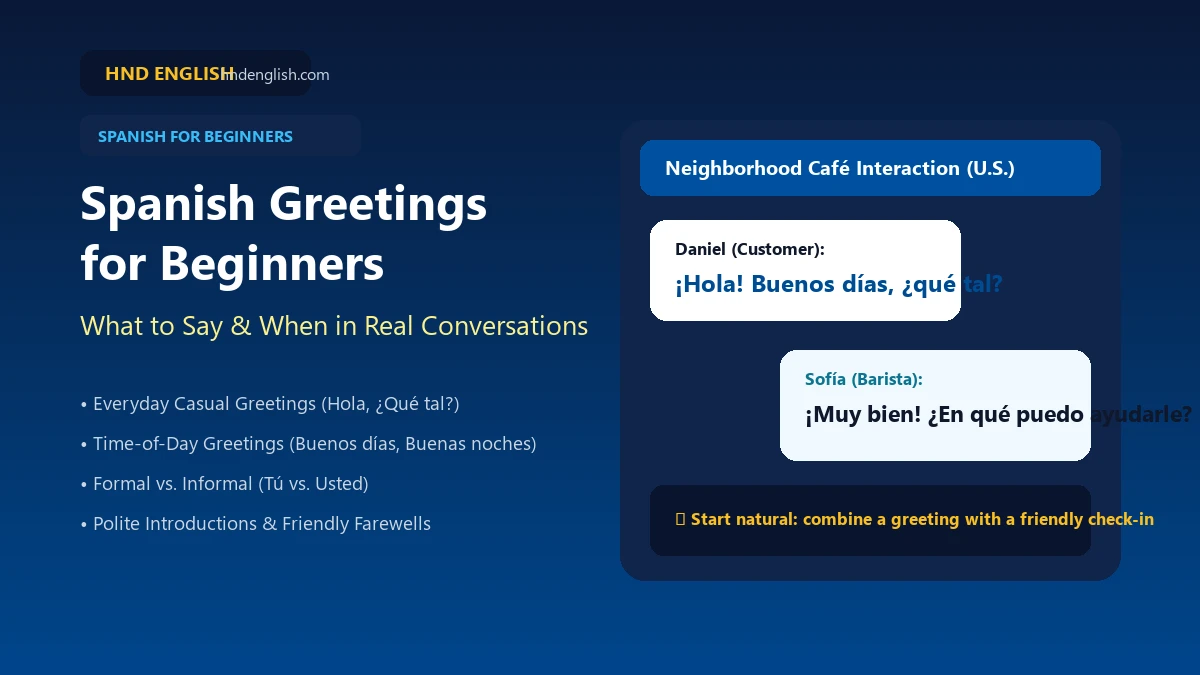
You walk into a café and someone greets you with a cheerful ¡Buenas!
You know hola means hello, but buenas wasn't the greeting you practiced. Is it another way to say good morning? Is it informal? And how should you respond?
Small moments like this are where language learning becomes real. Knowing how to translate "hello" into Spanish is useful. Knowing which greeting fits the moment—and what to say next—is even better.
Spanish greetings change depending on the time of day, how well you know someone, and sometimes the country or community you're in. The good news is that you don't need dozens of complicated expressions to start having friendly conversations.
In this guide: We'll explore everyday Spanish greetings, polite introductions, informal expressions, natural responses, and farewells with realistic conversation examples and simple practice exercises. By the end, you'll feel comfortable choosing a greeting instead of relying on hola for every situation.
Quick Answer: The Most Useful Spanish Greetings
If you only have a minute, start with these essential expressions:
| Spanish | English Meaning | When to Use It |
|---|---|---|
| ¡Hola! | Hello / Hi | Almost any everyday situation |
| Buenos días | Good morning | Morning until noon |
| Buenas tardes | Good afternoon / evening | Afternoon and early evening |
| Buenas noches | Good evening / good night | Evening greeting OR nighttime farewell |
| ¿Cómo estás? | How are you? | Informal (friends, peers, family) |
| ¿Cómo está usted? | How are you? | Formal (elders, clients, workplace) |
| ¿Qué tal? | How's it going? | Friendly, casual conversation |
| Mucho gusto | Nice to meet you | First introductions |
| Hasta luego | See you later | Standard polite farewell |
| Nos vemos | See you | Casual farewell among peers |
Quick Learning Tip:
Start with three expressions: ¡Hola!, ¿Cómo estás?, and Mucho gusto. Together, they let you greet someone, ask how they are doing, and respond politely to any introduction.The simplest answer is:
It's widely understood and works in almost every formal and informal situation. You can say hola when meeting a friend, greeting a coworker, or beginning a conversation with someone you don't know.
Saying More Than Just Hola
Compare these examples:
Each expression begins with the same familiar word but serves a slightly different purpose. A simple greeting can naturally become the opening of a real conversation.
Do Spanish Speakers Always Say Hola?
No. Depending on the region and relationship, people may begin with buenas, ¿qué tal?, ¿qué pasa?, or another familiar expression. Learning these variations helps you understand conversations that don't follow beginner textbook formulas.
For a broader introduction to everyday vocabulary, explore our English-to-Spanish Translation Guide.
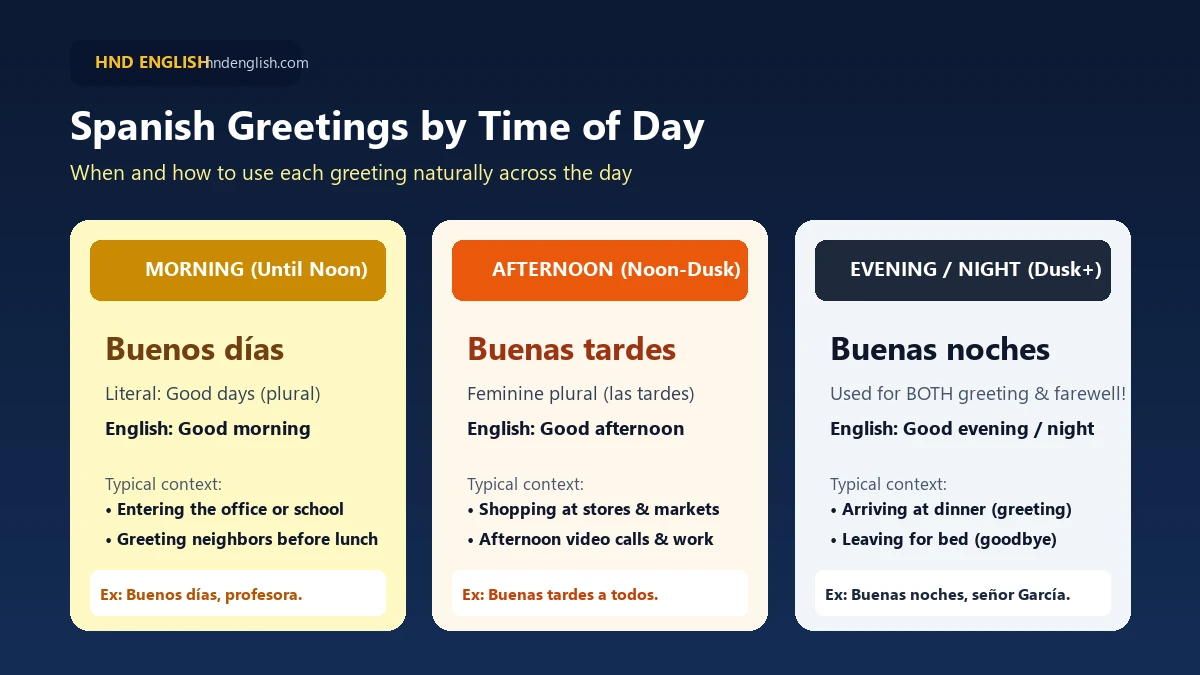
English speakers often say "good morning," "good afternoon," or "good evening" according to the time. Spanish also uses time-based greetings, but the boundaries aren't always identical across regions.
Buenos días — Good Morning
Buenos días is a standard morning greeting. You might use it when entering an office, greeting a neighbor, or meeting a teacher before class.
Buenas tardes — Good Afternoon
Buenas tardes is commonly used from noon until dusk (the afternoon and early evening).
Buenas noches — Good Evening or Good Night
One interesting difference from English is that buenas noches functions both when greeting someone at night and when saying goodbye before bed.
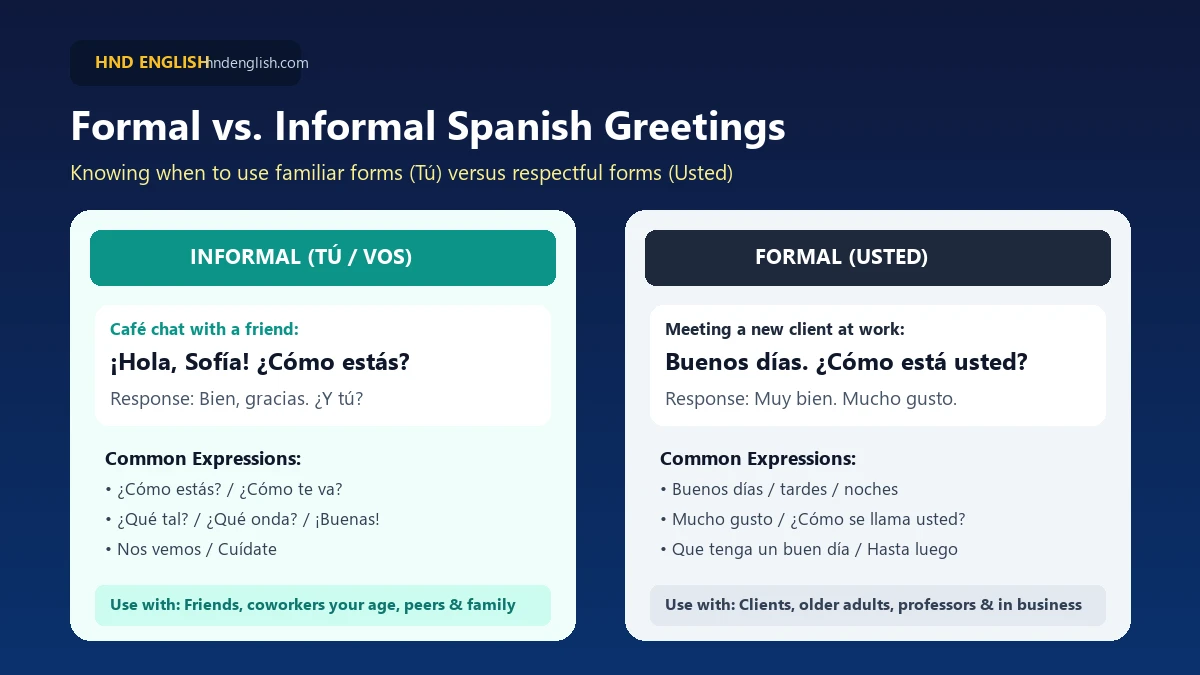
Imagine two situations. In the first, you meet a close friend at a café. In the second, you're meeting a new client at work. You wouldn't use exactly the same tone in English, and Spanish also distinguishes familiar and more formal communication through verb forms and pronouns.
¡Hola, Sofía! ¿Cómo estás?
Hi, Sofía. How are you?
Buenos días, señora López. ¿Cómo está usted?
Good morning, Ms. López. How are you?
The difference is not simply politeness versus rudeness; it reflects social relationships and respectful context.
You know how to say hello, and someone replies: ¿Cómo estás? Now what? A useful response doesn't have to be complicated. Here are natural options:
| Spanish Response | English Meaning |
|---|---|
| Estoy bien, gracias | I'm well, thank you |
| Muy bien | Very well |
| Todo bien | Everything's good |
| Más o menos | So-so / okay |
| Estoy un poco cansado/a | I'm a little tired |
| No muy bien | Not very well |
| Bien, ¿y tú? | Good, and you? (informal) |
| Bien, ¿y usted? | Good, and you? (formal) |
The Importance of Asking Back
Asking ¿y tú? or ¿y usted? keeps conversations reciprocal rather than ending on a one-word answer.
Textbook expressions are useful, but conversations between friends sound more varied:
Meaning: How's it going?
A flexible, widely used expression across Spain and Latin America.
Meaning: What's happening? / What's up?
Very familiar and informal. Can also ask what is occurring.
Meaning: What's up? / What's going on?
Especially associated with Mexican Spanish and common in U.S. communities.
Meaning: Hi! / Hello!
Relaxed shortened greeting used as a casual time-of-day shortcut.
Regional Language Tip:
Spanish is spoken across more than 20 countries and varied U.S. communities. Expressions natural in one place may sound foreign in another. Learn widely understood phrases like hola and ¿qué tal? first, then adopt local varieties.
A greeting is often followed by a short introduction:
In formal settings, use ¿Cómo se llama usted? or introduce yourself: "Buenos días. Mi nombre es Daniel. Mucho gusto."
You don't have to travel abroad to practice Spanish. Here are four common real-life American situations:
You: ¡Hola! ¿Qué tal?
Neighbor: Muy bien, gracias. ¿Y tú?
You: Todo bien.
You: Buenos días.
Employee: Buenos días. ¿En qué puedo ayudarle?
You: Solo estoy mirando, gracias.
You: Hola, soy Emily. Mucho gusto.
Coworker: Mucho gusto, Emily. Soy Andrés.
You: Encantada.
You: Buenas tardes a todos. ¿Cómo están?
Colleagues: Muy bien, gracias.
Addressing groups with a todos and ¿cómo están? is widely standard.
Written and spoken greetings often overlap, but phone and messaging habits carry distinct regional flavors:
📱 In Text Messages:
📞 Answering a Phone Call:
Starting a conversation matters, but ending it politely matters just as much. Here are common Spanish farewells:
| Spanish | English Meaning | Typical Context |
|---|---|---|
| Adiós | Goodbye | General farewell |
| Hasta luego | See you later | Widely useful standard goodbye |
| Hasta mañana | See you tomorrow | When meeting again next day |
| Nos vemos | See you | Casual everyday farewell |
| Hasta pronto | See you soon | When expecting to meet soon |
| Que tengas un buen día | Have a good day | Informal singular (tú) |
| Que tenga un buen día | Have a good day | Formal singular (usted) |
| Cuídate | Take care | Informal singular |
Remember that buenas noches is both an evening greeting and a nighttime goodbye.
Pay attention to the verb form: ¿Cómo estás? (informal) vs. ¿Cómo está usted? (formal).
Expressions like ¿qué onda? or ¿qué hubo? are regional. Start with universally understood phrases.
Follow up with a simple check-in: Hola, ¿cómo estás? or Hola, ¿qué tal?
For deeper advice on avoiding literal phrasing errors, read our guide to 12 English-to-Spanish Translation Mistakes.
Instead of memorizing an entire script, practice these 5 steps in order:
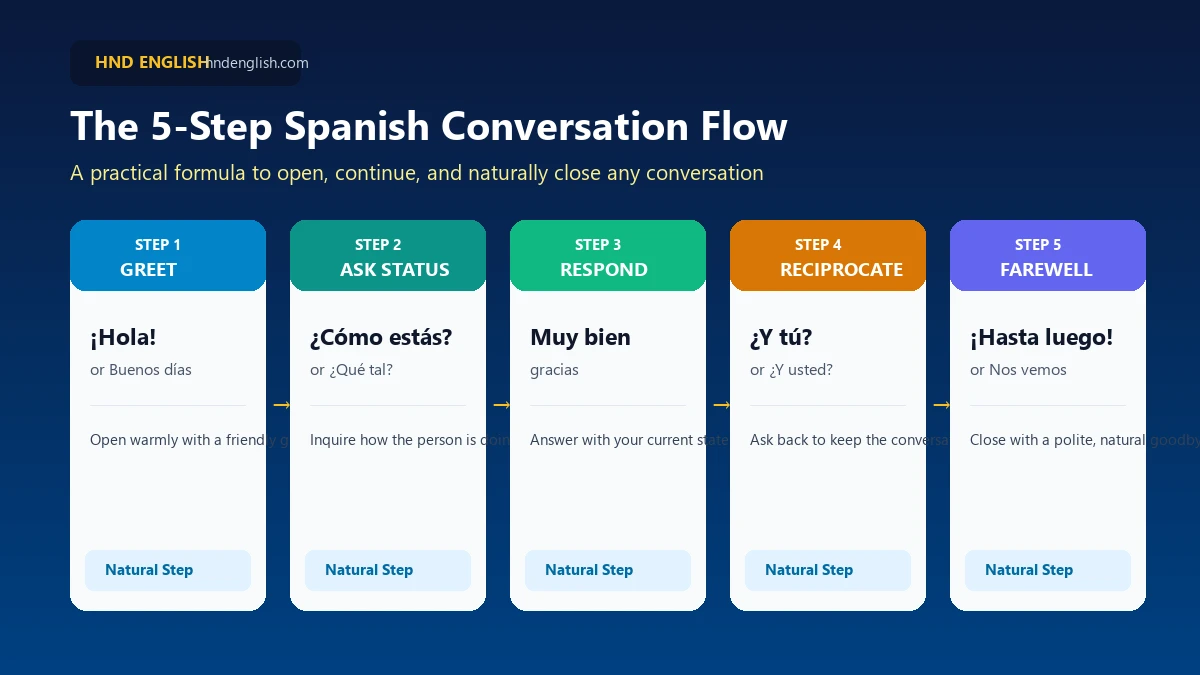
Practice Checklist: Try Before Your Next Conversation
- ☑️ Say hola naturally without hesitation.
- ☑️ Choose a suitable time-of-day greeting (Buenos días / tardes).
- ☑️ Ask someone how they are (¿Cómo estás?).
- ☑️ Give a complete response (Muy bien, gracias).
- ☑️ Ask a quick follow-up question (¿Y tú?).
- ☑️ Finish with an appropriate goodbye (¡Hasta luego!).
Test your conversational instincts with these 5 quick scenarios:
Question 1: You meet your Spanish-speaking friend at a café. Which is more natural?
A. ¿Cómo está usted? | B. ¿Cómo estás?
Question 2: You greet a new professional contact in a formal setting. Which expression fits?
A. Buenos días. Mucho gusto. | B. ¿Qué onda?
Question 3: You're leaving a conversation and expect to meet the person tomorrow. What do you say?
Question 4: Someone asks "¿Cómo estás?". How could you reply politely and ask back?
Question 5: You meet someone at 8:00 PM and want to greet them. Can you use "buenas noches"?
👉 Click here to reveal the answers
Recommended Video: Spanish Greetings in Real Conversations
Watch this lesson by Spanish and Go demonstrating real-life formal and informal greetings, goodbyes, and Mexican conversational expressions:

Frequently Asked Questions About Spanish Greetings
What is the most common Spanish greeting?
Hola is the most widely recognized greeting. It works in almost every situation, alongside time-based greetings like buenos días.
How do you greet someone respectfully in Spanish?
Use buenos días, buenas tardes, or buenas noches, followed by the formal question ¿Cómo está usted?.
What's the difference between Hola and Buenas?
Hola is the universal word for hello. Buenas is a shortened, colloquial greeting common in Spain and parts of Latin America.
Is Qué Tal formal or informal?
¿Qué tal? is friendly and conversational (informal). It functions like "how's it going?".
How do you respond to Cómo Estás?
You can answer with estoy bien, gracias, muy bien, or más o menos, and ask back with ¿y tú?.
Can Buenas Noches mean both good evening and good night?
Yes! Spanish uses buenas noches both when arriving in the evening and when departing at night.
Explore More Spanish & Language Resources:
Which Spanish greeting have you heard in real life but weren't sure how to use?
Share it in the comments below! Your question might help another beginner navigate everyday Spanish conversations.
Save Complete Educational Notes as PDF
Download a clean, printer-friendly formatted PDF of this note for offline revision.
Found this study material helpful?
Rate our website service and free notes repository on Google Reviews!
Discussion & Study Inquiries (0)
Ask questions, request missing past papers, or share revision notes
No comments yet. Be the first student to start the discussion or request past papers!