
English to Spanish: 100 Common Words and Phrases for Beginners
Imagine walking into a small coffee shop in Miami. The person behind the counter greets you in Spanish, and you recognize the word hola. You smile, but when they ask another question, you're suddenly unsure how to respond. You might know a few Spanish words already. Turning those words into an actual conversation is the next step. Learning english to spanish doesn't have to begin with complicated grammar lessons or hundreds of vocabulary flashcards. A few practical expressions can help you greet someone, order food, ask questions, and feel more comfortable speaking with Spanish-speaking friends, neighbors, or coworkers. This guide brings together 100 common Spanish words and phrases, organized around everyday situations. You'll also learn how to use them naturally, avoid frequent translation mistakes, and practice without feeling overwhelmed.
Why Learning Everyday Spanish Is a Good Place to Start
Spanish is part of everyday life in many communities across the United States. You may hear it in restaurants, stores, workplaces, schools, or conversations with neighbors and friends.
Being able to say something simple, such as ¿Cómo estás? (How are you?) or Muchas gracias (Thank you very much), can make a conversation more welcoming.
But memorizing a translation isn't always enough.
Take the English expression "Good evening." Spanish speakers commonly use buenas tardes during the afternoon and earlier evening, while buenas noches is used later in the evening and at night. The best choice depends on the time and context.
That's why this article includes not only translations but also explanations of when and how to use them.
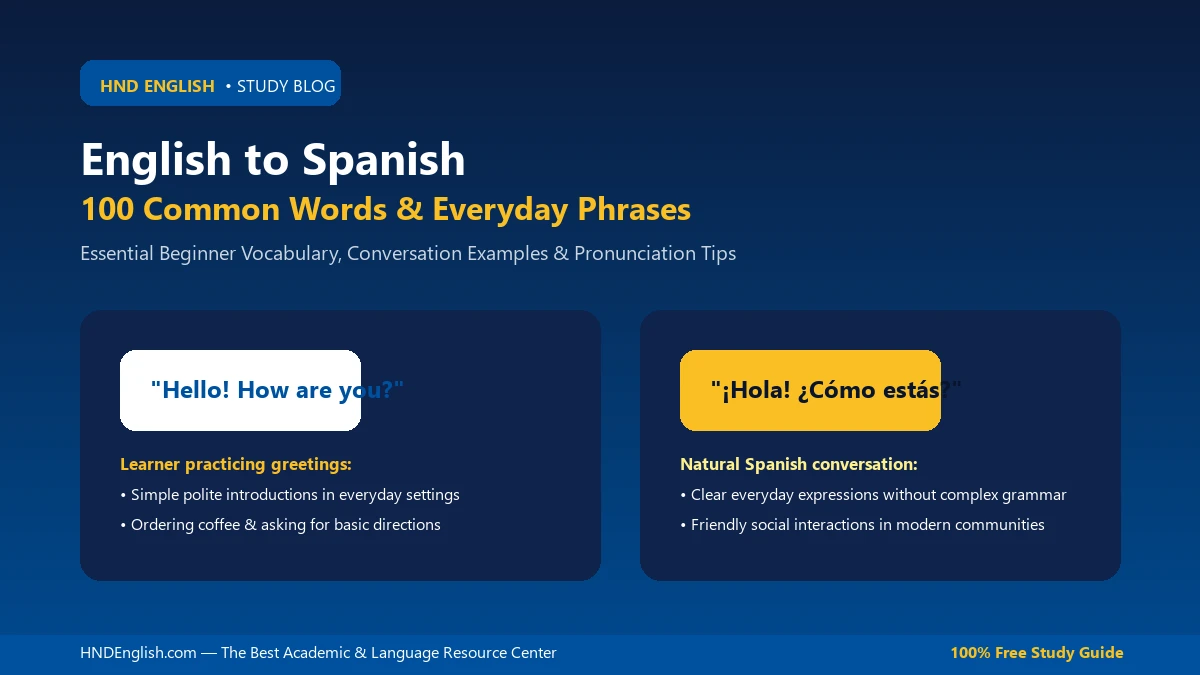
Greetings are some of the easiest expressions to practice because you'll encounter opportunities to use them almost every day.
| No. | English Expression | Spanish Translation |
|---|---|---|
| 1 | Hello | Hola |
| 2 | Good morning | Buenos días |
| 3 | Good afternoon | Buenas tardes |
| 4 | Good evening / Good night | Buenas noches |
| 5 | Goodbye | Adiós |
| 6 | See you later | Hasta luego |
| 7 | See you tomorrow | Hasta mañana |
| 8 | How are you? (informal) | ¿Cómo estás? |
| 9 | How's it going? | ¿Qué tal? |
| 10 | Nice to meet you | Mucho gusto |
Using Greetings in a Real Conversation
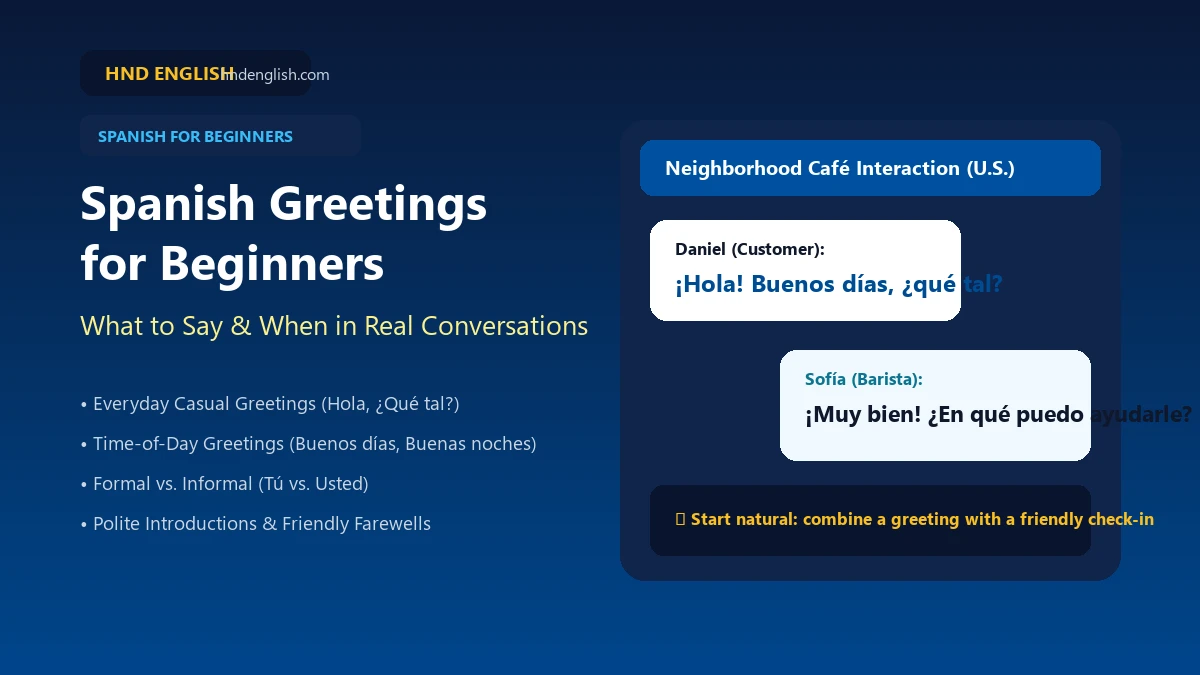
Imagine meeting a new neighbor:
An important distinction: ¿Cómo estás? is informal. When speaking more formally to an elder or professional, ¿Cómo está usted? is an appropriate alternative.
Good manners travel well between languages. These expressions are particularly useful in restaurants, stores, offices, and everyday social situations.
| No. | English Expression | Spanish Translation |
|---|---|---|
| 11 | Please | Por favor |
| 12 | Thank you | Gracias |
| 13 | Thank you very much | Muchas gracias |
| 14 | You're welcome | De nada |
| 15 | Excuse me (getting attention, formal) | Disculpe |
| 16 | I'm sorry | Lo siento |
| 17 | No problem | No hay problema |
| 18 | Of course | Por supuesto |
| 19 | With permission / Excuse me (passing by) | Con permiso |
| 20 | Have a good day | Que tengas un buen día |
What's the Difference Between Disculpe and Con permiso?
Both can translate to "excuse me," but they aren't always interchangeable.
- Use disculpe when politely attracting someone's attention, apologizing, or asking a question in a formal context.
- Use con permiso when passing through a crowded space or politely interrupting someone to move past.
Once you know basic greetings, the next step is introducing yourself and talking about familiar things.
| No. | English Expression | Spanish Translation |
|---|---|---|
| 21 | My name is... | Me llamo... |
| 22 | What's your name? (informal) | ¿Cómo te llamas? |
| 23 | I am from the United States | Soy de Estados Unidos |
| 24 | Where are you from? (informal) | ¿De dónde eres? |
| 25 | I speak English | Hablo inglés |
| 26 | I'm learning Spanish | Estoy aprendiendo español |
| 27 | I don't understand | No entiendo |
| 28 | Could you repeat that? (informal) | ¿Puedes repetirlo? |
| 29 | Please speak more slowly (informal) | Habla más despacio, por favor |
| 30 | It's nice to see you | Me alegra verte |
Knowing how to ask questions allows you to move beyond memorized greetings and begin finding information.
| No. | English Question | Spanish Translation |
|---|---|---|
| 31 | What is this? | ¿Qué es esto? |
| 32 | Where is it? | ¿Dónde está? |
| 33 | Who is that? | ¿Quién es? |
| 34 | When? | ¿Cuándo? |
| 35 | Why? | ¿Por qué? |
| 36 | How? | ¿Cómo? |
| 37 | How much does it cost? | ¿Cuánto cuesta? |
| 38 | Do you speak English? (informal) | ¿Hablas inglés? |
| 39 | Can you help me? (informal) | ¿Puedes ayudarme? |
| 40 | What does this mean? | ¿Qué significa esto? |
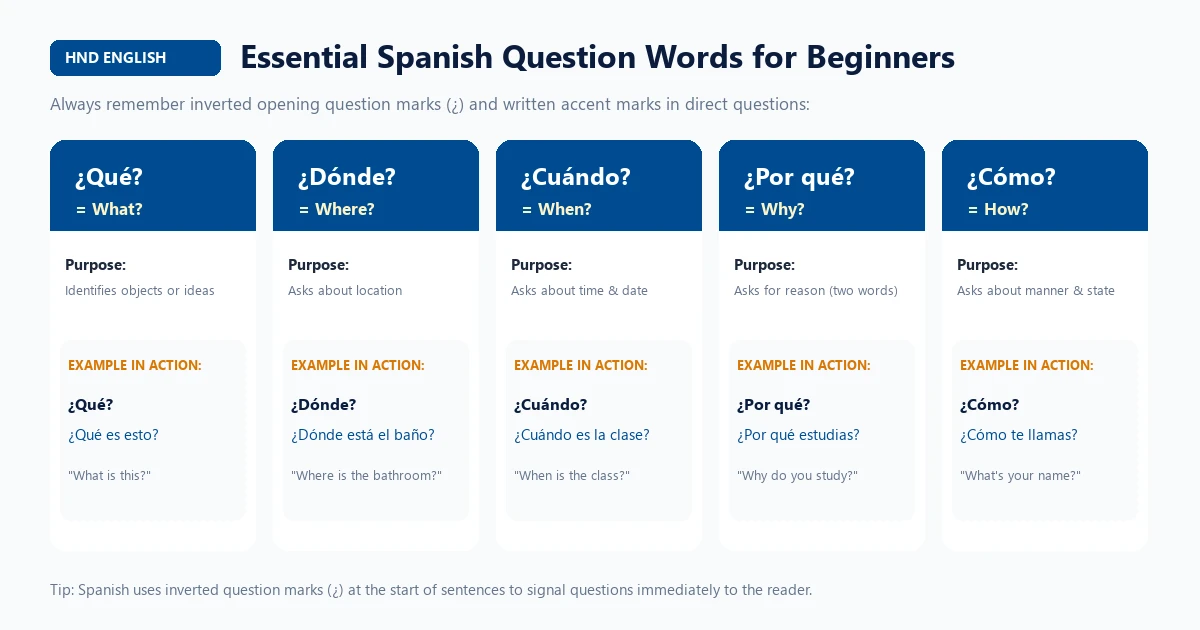
These simple words can help you identify people, talk about family members, and describe relationships.
| No. | English Word | Spanish Translation |
|---|---|---|
| 41 | I | Yo |
| 42 | You (informal singular) | Tú |
| 43 | We | Nosotros / Nosotras |
| 44 | Friend | Amigo / Amiga |
| 45 | Family | Familia |
| 46 | Mother | Madre |
| 47 | Father | Padre |
| 48 | Brother | Hermano |
| 49 | Sister | Hermana |
| 50 | Child | Niño / Niña |
If you'd like a refresher on how nouns, pronouns, adjectives, and other word types operate across languages, read our Word Classes in English guide.
Imagine visiting a Spanish-speaking restaurant or ordering from someone who prefers Spanish. Learning a few food expressions can make the experience comfortable and enjoyable.
| No. | English Expression | Spanish Translation |
|---|---|---|
| 51 | Water | Agua |
| 52 | Coffee | Café |
| 53 | Tea | Té |
| 54 | Milk | Leche |
| 55 | Bread | Pan |
| 56 | Rice | Arroz |
| 57 | Chicken | Pollo |
| 58 | I would like a coffee | Quisiera un café |
| 59 | The menu, please | El menú, por favor |
| 60 | The check, please | La cuenta, por favor |
Travel expressions are useful for navigating a new city, asking about transportation, and finding important places.
| No. | English Phrase | Spanish Translation |
|---|---|---|
| 61 | Where is the bathroom? | ¿Dónde está el baño? |
| 62 | Where is the hotel? | ¿Dónde está el hotel? |
| 63 | I need a taxi | Necesito un taxi |
| 64 | Where is the bus stop? | ¿Dónde está la parada de autobús? |
| 65 | Turn left | Gira a la izquierda |
| 66 | Turn right | Gira a la derecha |
| 67 | Go straight ahead | Sigue recto |
| 68 | I am lost | Estoy perdido / perdida |
| 69 | Is it far? | ¿Está lejos? |
| 70 | I need directions | Necesito indicaciones |
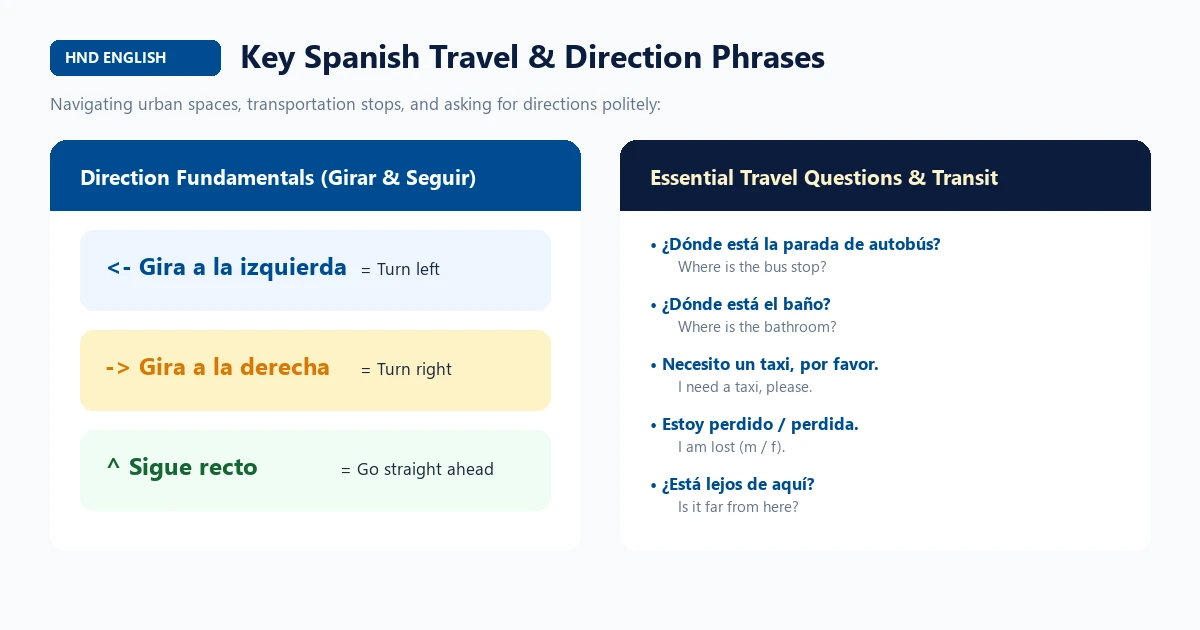
Shopping conversations often involve prices, preferences, quantities, and payment.
| No. | English Phrase | Spanish Translation |
|---|---|---|
| 71 | I want this | Quiero esto |
| 72 | I need this | Necesito esto |
| 73 | It's expensive | Es caro |
| 74 | It's cheap / inexpensive | Es barato |
| 75 | Do you have another size? (formal) | ¿Tiene otra talla? |
| 76 | I'm just looking | Solo estoy mirando |
| 77 | Can I pay by card? | ¿Puedo pagar con tarjeta? |
| 78 | Cash | Efectivo |
| 79 | How much is everything? | ¿Cuánto es todo? |
| 80 | I'll take it | Me lo llevo |
Numbers and time expressions are useful for appointments, prices, transportation, and everyday conversation.
| No. | English Concept | Spanish Translation |
|---|---|---|
| 81 | One | Uno |
| 82 | Two | Dos |
| 83 | Three | Tres |
| 84 | Four | Cuatro |
| 85 | Five | Cinco |
| 86 | Today | Hoy |
| 87 | Tomorrow | Mañana |
| 88 | Yesterday | Ayer |
| 89 | What time is it? | ¿Qué hora es? |
| 90 | It's three o'clock | Son las tres |
A few additional expressions can help you communicate more clearly when you're confused, uncomfortable, or need assistance.
| No. | English Expression | Spanish Translation |
|---|---|---|
| 91 | I need help | Necesito ayuda |
| 92 | Call the police | Llame a la policía |
| 93 | I need a doctor | Necesito un médico |
| 94 | Where is the hospital? | ¿Dónde está el hospital? |
| 95 | I'm sick | Estoy enfermo / enferma |
| 96 | I'm tired | Estoy cansado / cansada |
| 97 | I'm hungry | Tengo hambre |
| 98 | I'm thirsty | Tengo sed |
| 99 | Be careful! | ¡Cuidado! |
| 100 | Everything is fine | Todo está bien |
How to Pronounce Spanish Words More Naturally
One encouraging thing about learning Spanish is that its spelling and pronunciation are generally more consistent than English. Start with the five vowels:
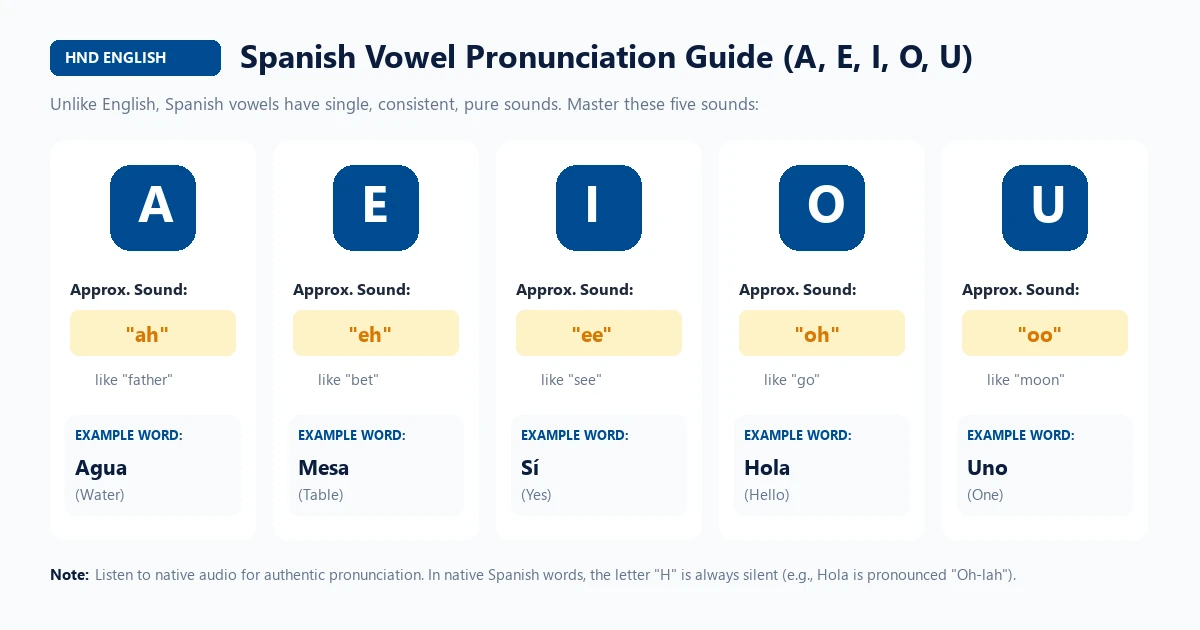
- The letter h is normally silent in native Spanish words (e.g., Hola begins with an "O" sound).
- The letter j produces an aspirated sound similar to an English "h".
- The letter ñ, as in baño, sounds like the "ny" in canyon.
- Written accent marks (tildes) indicate where syllable stress falls and distinguish homographs.
Three Common English-to-Spanish Translation Mistakes
Saying "I am hungry" is expressed as Tengo hambre ("I have hunger"). Expecting Spanish to mirror English syntax leads to unnatural expressions.
Distinguish between ¿Cómo estás? (informal for friends) and ¿Cómo está usted? (formal for elders and professional settings).
A word like mañana can mean "tomorrow" or "morning" depending on context. Check our companion English-to-Spanish translation guide for advanced grammar rules.
A Simple Seven-Day Practice Plan
| Day | Practice Focus | Small Daily Goal |
|---|---|---|
| Monday | Greetings | Introduce yourself aloud in front of a mirror |
| Tuesday | Polite phrases | Practice a short cafe or store dialogue |
| Wednesday | Questions | Ask five simple questions (Qué, Dónde, Cuándo, etc.) |
| Thursday | Family & people | Describe three friends or family members |
| Friday | Food & shopping | Practice ordering food and requesting the check |
| Saturday | Travel & time | Ask for directions (izquierda, derecha) and tell time |
| Sunday | Review | Combine phrases into a complete one-minute dialogue |
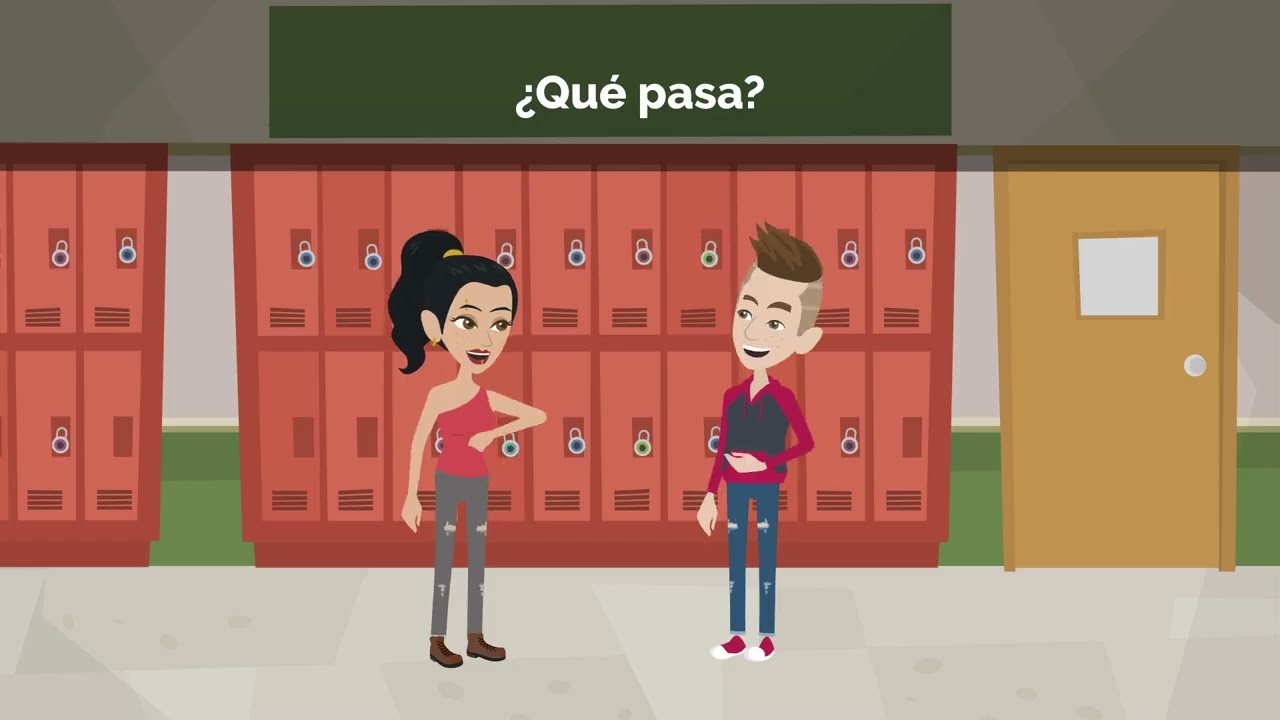
Recommended Video: Practice Spanish Greetings and Conversations
Listen to everyday Spanish greetings and practical conversations, then practice the expressions from this guide:
Frequently Asked Questions
What are the most useful Spanish words for beginners?
Start with hola (hello), gracias (thank you), por favor (please), sí (yes), no (no), perdón (excuse me), and ayuda (help). Then learn complete expressions such as ¿Cómo estás? and No entiendo.
Is English to Spanish difficult to learn?
Spanish introduces concepts like grammatical gender and verb conjugation, but pronunciation is consistent and everyday conversational phrases can be used immediately.
Should I learn Spanish words or complete sentences first?
Learn both, but prioritize useful phrases. Knowing that agua means water is helpful; knowing quisiera agua, por favor allows you to make a polite real-world request.
Start Speaking With What You Already Know
You don't have to wait until your Spanish is perfect to begin using it. Start with a greeting. Ask a simple question. Practice ordering a coffee. Learn how to say that you don't understand something. Little by little, conversations begin to feel natural and enjoyable.
Which Spanish expression would you like to learn next? Share it in the comments below, or tell us about a phrase you've heard but never fully understood!
Further Learning & Related References:
Save Complete Educational Notes as PDF
Download a clean, printer-friendly formatted PDF of this note for offline revision.
Found this study material helpful?
Rate our website service and free notes repository on Google Reviews!
Discussion & Study Inquiries (0)
Ask questions, request missing past papers, or share revision notes
No comments yet. Be the first student to start the discussion or request past papers!