
English to Sinhala Translation: 40 Everyday Sentences You Can Actually Use
You've learned English for years. You can read simple sentences, recognize familiar words, and probably understand quite a lot when someone speaks slowly.
But imagine someone suddenly asks you a question in English at a bus stop, in a classroom, or during a job interview. You know what you want to say in Sinhala. The difficult part is finding the right English words quickly enough.
That experience is familiar to many language learners across Sri Lanka. The problem is not always vocabulary. Often, it's sentence structure, choosing the right expression, or trying to translate every word directly from Sinhala into English.
This guide approaches English-to-Sinhala translation differently. Instead of presenting a long list of disconnected words, we'll explore 40 useful everyday English sentences with Sinhala meanings, grouped around situations you actually experience in daily life.
Target Audience: Sri Lankan students, university applicants, job seekers, and everyday learners looking to communicate with confidence at work, school, and social settings.
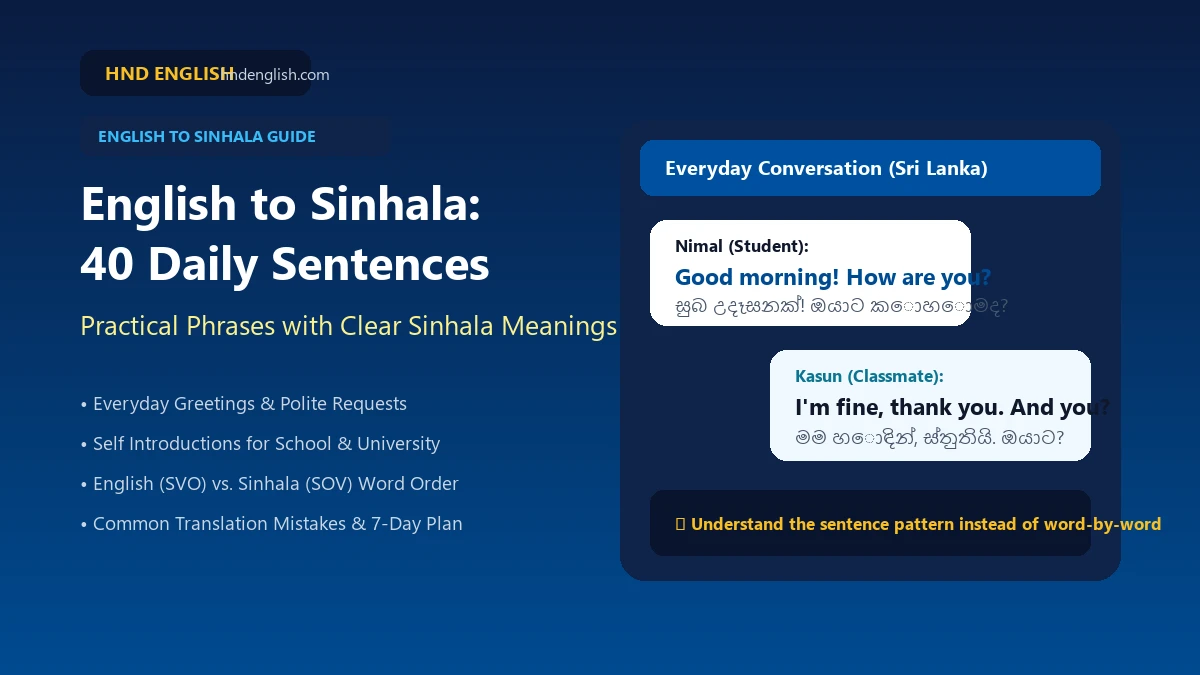
Quick Start: Five Useful English Sentences With Sinhala Meanings
You can begin practicing immediately with these five essential expressions:
| English Sentence | Sinhala Meaning (සිංහල තේරුම) | Context |
|---|---|---|
| How are you? | ඔයාට කොහොමද? | Friendly check-in |
| Thank you | ස්තුතියි | Universal politeness |
| I don't understand | මට තේරෙන්නේ නැහැ | When you need clarification |
| Can you help me? | ඔයාට මට උදව් කරන්න පුළුවන්ද? | Polite question for assistance |
| See you tomorrow | හෙට හමුවෙමු | Polite departure |
Study Tip:
Read the English sentence first, cover the Sinhala column, and say its meaning aloud. Then reverse the exercise: read the Sinhala meaning and form the English sentence. Understanding both directions builds real conversational speed.Greetings are a practical place to begin because they appear in conversations at home, school, universities, workplaces, and shops:
| No. | English Expression | Sinhala Meaning (සිංහල තේරුම) |
|---|---|---|
| 1 | Hello | ආයුබෝවන් / හෙලෝ |
| 2 | Good morning | සුබ උදෑසනක් |
| 3 | How are you? | ඔයාට කොහොමද? |
| 4 | I'm fine | මම හොඳින් |
| 5 | Thank you | ස්තුතියි |
| 6 | Please | කරුණාකර |
| 7 | Excuse me / Sorry | සමාවෙන්න |
| 8 | See you tomorrow | හෙට හමුවෙමු |
Why One English Greeting Can Have Different Sinhala Equivalents
Consider the English word hello. In formal or traditional situations, you might say ආයුබෝවන්. But in casual conversations among friends, Sri Lankans frequently say හෙලෝ or use informal greetings. Similarly, while "Good morning" is ideal for teachers or colleagues, "Hi!" is more natural with close friends. Good translation requires matching the situation, not just copying a dictionary.
A Short Practice Conversation:
Introducing yourself is essential in school, university, job interviews, and everyday social settings:
| No. | English Expression | Sinhala Meaning (සිංහල තේරුම) |
|---|---|---|
| 9 | My name is Nimal | මගේ නම නිමල් |
| 10 | What is your name? | ඔයාගේ නම මොකක්ද? |
| 11 | I am from Colombo | මම කොළඹින් |
| 12 | Where do you live? | ඔයා ජීවත් වෙන්නේ කොහෙද? |
| 13 | I am learning English | මම ඉංග්රීසි ඉගෙන ගන්නවා |
| 14 | I can speak a little English | මට ඉංග්රීසි ටිකක් කතා කරන්න පුළුවන් |
| 15 | I don't understand | මට තේරෙන්නේ නැහැ |
| 16 | Please say it again | කරුණාකර ආයෙත් කියන්න |
Making Your Introduction Sound Natural:
Instead of speaking in isolated fragments, connect your ideas:
"My name is Nimal. I'm from Colombo, and I'm learning English."
Notice that I'm is the contracted form of I am. Using contractions is natural and conversational in spoken English.
Asking questions politely is one of the most useful communication skills you can master:
| No. | English Expression | Sinhala Meaning (සිංහල තේරුම) |
|---|---|---|
| 17 | Where is the bathroom? | වැසිකිළිය කොහෙද? |
| 18 | Where is the bus stop? | බස් නැවතුම කොහෙද? |
| 19 | How much is this? | මේක කීයද? |
| 20 | I need help | මට උදව් ඕනේ |
| 21 | Can you help me? | ඔයාට මට උදව් කරන්න පුළුවන්ද? |
| 22 | Where is the school? | පාසල කොහෙද? |
| 23 | I'm late | මම පරක්කුයි |
| 24 | I'm on my way | මම එන ගමන් |
Everyday Situation: Finding a Classroom at Campus
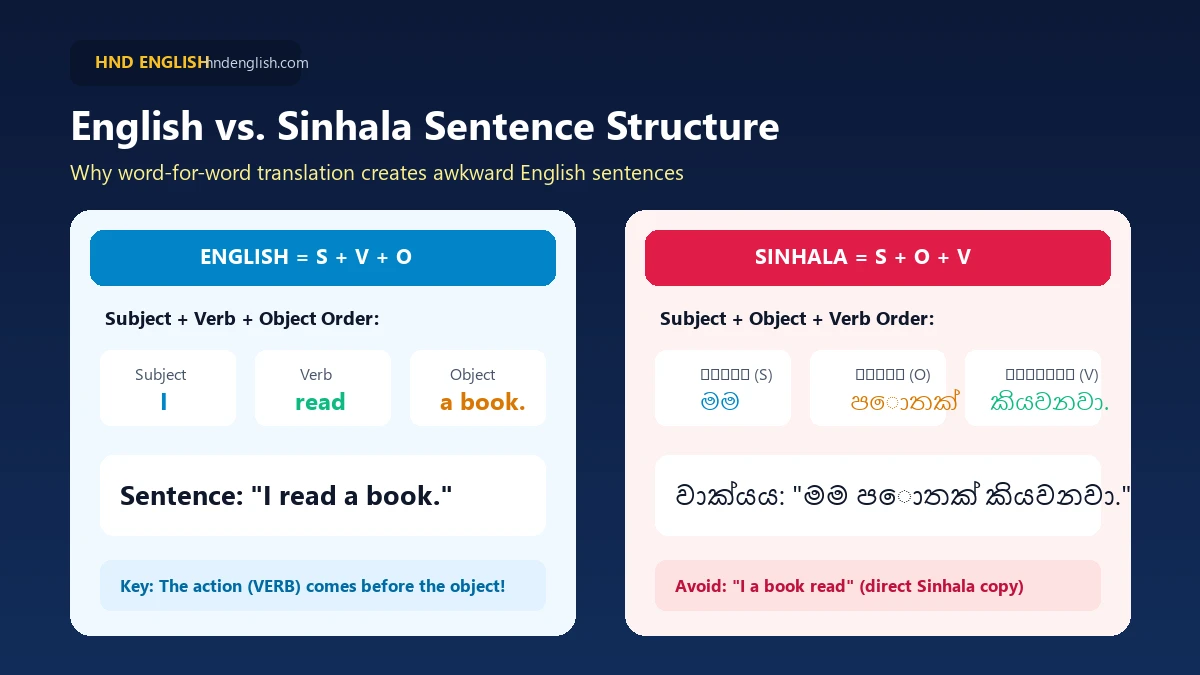
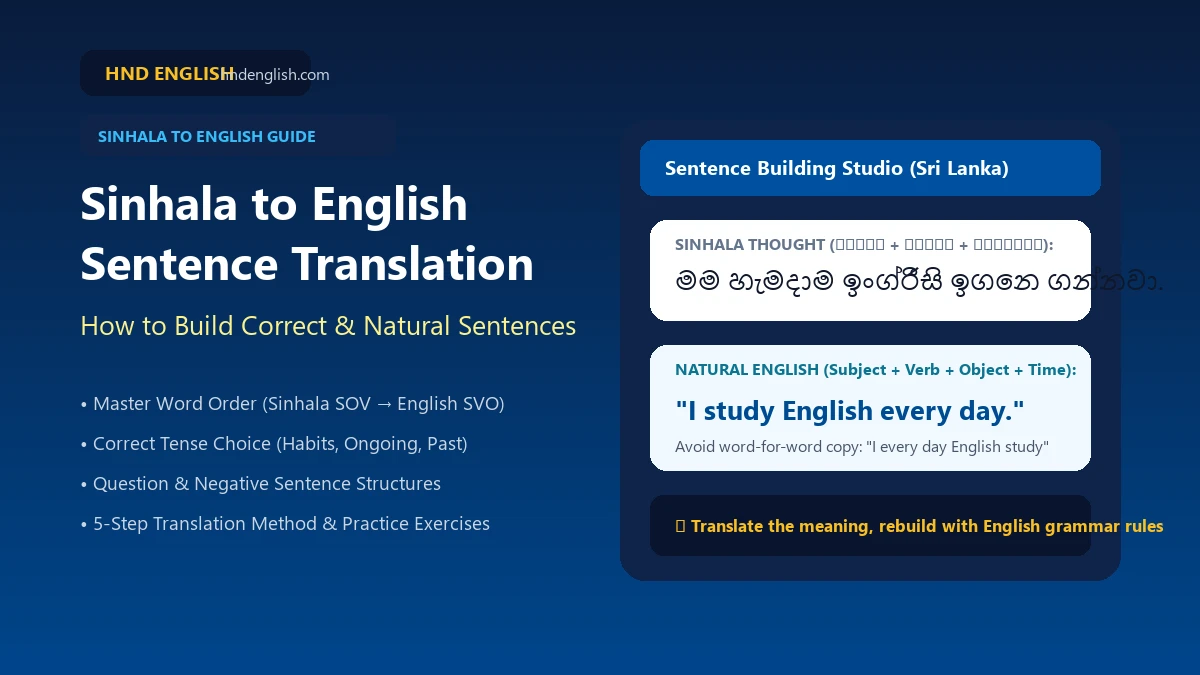
One of the biggest obstacles for Sri Lankan learners is word order. English and Sinhala arrange sentences in different fundamental patterns:
English: Subject + Verb + Object (SVO)
The verb appears before the object.
I (S) + read (V) + a book (O).
Sinhala: Subject + Object + Verb (SOV)
The object appears before the verb.
මම (S) + පොතක් (O) + කියවනවා (V).
| Function | English Word | Sinhala Word (සිංහල) |
|---|---|---|
| Subject (කර්තෘ) | I | මම |
| Object (කර්මය) | a book | පොතක් |
| Verb (ක්රියාව) | read | කියවනවා |
A learner who directly copies Sinhala word order into English may produce "I a book read." In English, the action comes first: "I read a book."
Want to learn more about parts of speech? Read our complete guide to Word Classes in English.
Everyday interactions at bakeries, cafés, and supermarkets are great opportunities to practice short expressions:
| No. | English Expression | Sinhala Meaning (සිංහල තේරුම) |
|---|---|---|
| 25 | I'm hungry | මට බඩගිනියි |
| 26 | I'm thirsty | මට තිබහයි |
| 27 | Please give me some water | මට වතුර ටිකක් දෙන්න |
| 28 | Please give me a tea | මට තේ එකක් දෙන්න |
| 29 | No sugar, please | සීනි එපා |
| 30 | Please give me the bill | බිල දෙන්න |
Direct request:
"Give me a tea."
Understood, but can sound abrupt in professional or formal dining.
More polite request:
"Could I have a cup of tea, please?"
Courteous, natural, and ideal for hospitality settings.
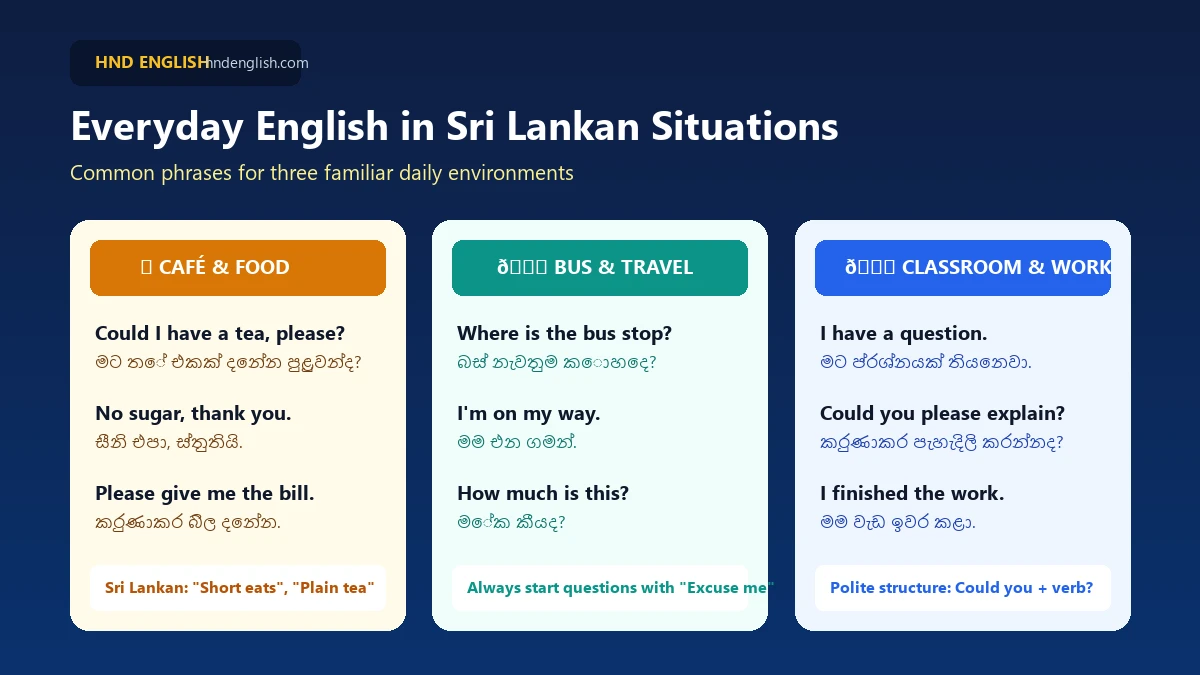
As you begin higher diploma studies, degree programs, or workplace training, these sentences help you interact respectfully:
| No. | English Expression | Sinhala Meaning (සිංහල තේරුම) |
|---|---|---|
| 31 | I have a question | මට ප්රශ්නයක් තියෙනවා |
| 32 | Please explain | කරුණාකර පැහැදිලි කරන්න |
| 33 | I forgot | මට අමතක වුණා |
| 34 | I finished the work | මම වැඩ ඉවර කළා |
| 35 | We have a meeting tomorrow | හෙට රැස්වීමක් තියෙනවා |
| 36 | Please send me a message | මට පණිවිඩයක් එවන්න |
| 37 | Wait a moment | මොහොතක් ඉන්න |
| 38 | Take care | පරිස්සමින් ඉන්න |
Useful Polite Request Patterns
Notice how using Could you + verb + please? transforms simple requests into professional English:
| Purpose | Useful Polite Expression |
|---|---|
| Asking for help | Could you please help me? |
| Asking for clarification | Could you explain that again, please? |
| Requesting location | Could you tell me where it is? |
| Asking permission | May I come in? |
| Asking someone to wait | Could you wait a moment, please? |
| No. | English Expression | Sinhala Meaning (සිංහල තේරුම) |
|---|---|---|
| 39 | Yes | ඔව් |
| 40 | No | නැහැ |
While "Yes" and "No" are complete answers, expanding your response makes conversations more communicative: "Yes, I understand" or "No, I don't understand. Could you explain it again?"
Grammatical structures differ completely between English and Sinhala. Focus first on the intended meaning, then form a natural expression.
Avoid copying Sinhala SOV word order. Remember that English places the verb before the object (SVO).
A direct command like "Give me the book" can sound harsh. Use "Could you please give me the book?" when speaking with teachers and colleagues.
Knowing words on a page is different from speaking fluently. Practice saying complete sentences out loud.
Machine tools often miss contextual nuances. Check the context before using automated output for formal communication.
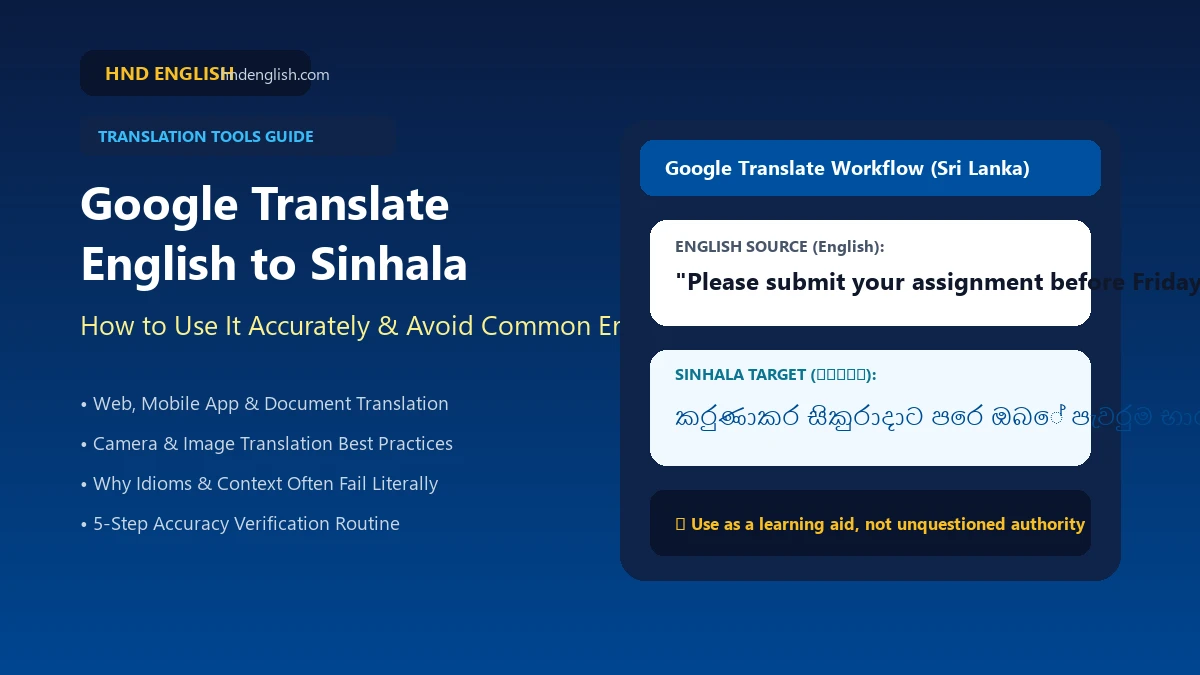
Google Translate is a convenient aid to explore vocabulary and verify spellings, but it requires mindful use:
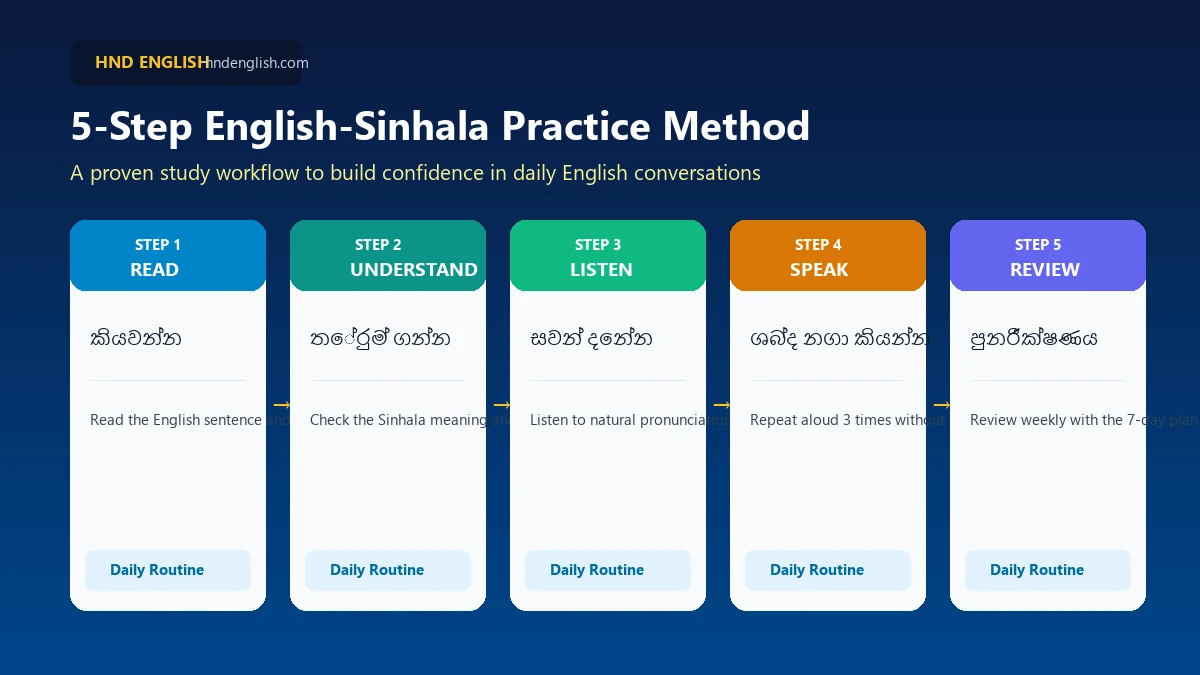
A Practical 5-Step Translation Workflow:
- Read the complete English sentence to grasp the full message.
- Identify the intended communicative meaning and tone.
- Review the generated Sinhala translation.
- Look up any unfamiliar words in a trusted dictionary.
- Confirm whether the phrasing sounds natural to native ears in that context.
You don't need to memorize all 40 sentences at once. Follow this simple routine:
| Day | Daily Focus Activity |
|---|---|
| Day 1 | Practice greetings and polite expressions (Sentences 1–8) |
| Day 2 | Introduce yourself in English (Sentences 9–16) |
| Day 3 | Practice asking for help and directions (Sentences 17–24) |
| Day 4 | Learn SVO vs. SOV sentence structure rules |
| Day 5 | Practice café and shopping conversations (Sentences 25–30) |
| Day 6 | Practice classroom and workplace English (Sentences 31–38) |
| Day 7 | Review all 40 sentences and speak aloud without looking at translations |
Try translating these 5 sentences into Sinhala without looking back at the tables:
- I don't understand.
- Can you help me?
- I'm learning English.
- Please send me a message.
- How much is this?
👉 Click here to reveal the answers
| English | Sinhala Meaning (සිංහල තේරුම) |
|---|---|
| I don't understand | මට තේරෙන්නේ නැහැ |
| Can you help me? | ඔයාට මට උදව් කරන්න පුළුවන්ද? |
| I'm learning English | මම ඉංග්රීසි ඉගෙන ගන්නවා |
| Please send me a message | මට පණිවිඩයක් එවන්න |
| How much is this? | මේක කීයද? |
Recommended Video: Practice English Through Sinhala
Watch this lesson by English Sinhalen Online demonstrating 50 everyday phrases with clear Sinhala explanations:

Frequently Asked Questions
How can I translate English to Sinhala correctly?
Focus on the intended meaning of the whole sentence rather than translating individual words. Verify word order (English SVO vs. Sinhala SOV) and appropriate politeness.
Is English-to-Sinhala translation difficult?
It can be challenging due to differences in syntax, but mastering common phrase patterns and everyday situation chunks makes rapid progress achievable.
How many English sentences should beginners learn daily?
Practicing 5 or 6 expressions thoroughly—saying them aloud and using them in context—is far more effective than trying to memorize dozens passively.
Why does the same English sentence have different Sinhala translations?
Sinhala has distinct formal written registers and colloquial spoken forms. The choice between ආයුබෝවන් and හෙලෝ depends on social setting and relationship.
Explore Related HND English Learning Resources:
Which everyday English sentence do you find hardest to translate into Sinhala?
Share your question in the comments below! It might become a featured example in our next HND English lesson.
Save Complete Educational Notes as PDF
Download a clean, printer-friendly formatted PDF of this note for offline revision.
Found this study material helpful?
Rate our website service and free notes repository on Google Reviews!
Discussion & Study Inquiries (0)
Ask questions, request missing past papers, or share revision notes
No comments yet. Be the first student to start the discussion or request past papers!