
Sinhala to English Translation: How to Build Correct Sentences
You know exactly what you want to say in Sinhala.
Maybe you're talking to a teacher, replying to an email at work, or answering a question during a job interview. The idea is crystal clear in your mind. But when you try to say it in English, you pause: Which word comes first? Should I say "I go", "I am going", or "I went"?
And why does a sentence that makes perfect sense in Sinhala sometimes sound strange when translated word for word into English?
This is one of the most familiar challenges for Sri Lankan learners. The solution isn't memorizing thousands of isolated translations. It's understanding how English sentences are constructed and learning to express the same meaning naturally.
In this guide: We'll explore Sinhala to English sentence translation step by step—with grammar patterns, tense guidelines, common pitfalls, and practical exercises to turn your Sinhala thoughts into clear, natural English.
Quick Answer: How Do You Translate Sinhala Sentences Into English?
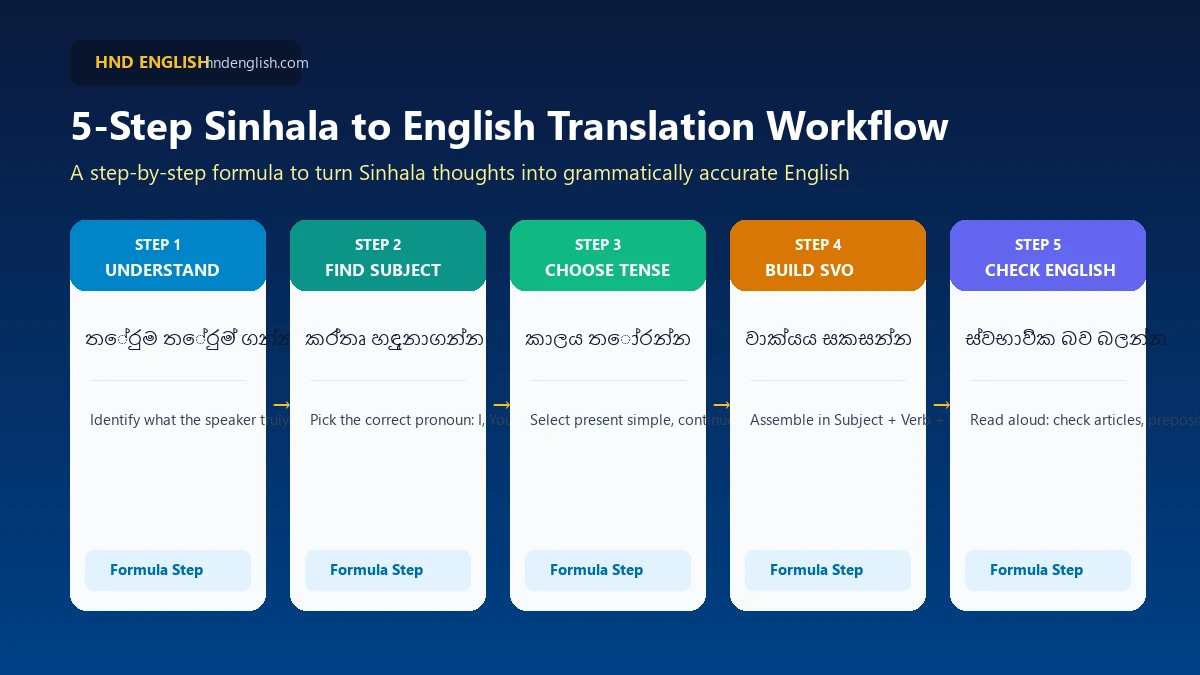
A reliable beginner translation method follows five steps:
- Understand what the Sinhala sentence means (the core communicative message).
- Identify who or what the sentence is about (the grammatical subject).
- Choose the correct English verb and tense (habitual, ongoing now, or completed in the past).
- Arrange the words in English pattern (Subject + Verb + Object).
- Read aloud to verify that the phrasing sounds natural.
✅ Natural English: "I read a book." (or "I am reading a book" if happening right now).
Key Principle:
Good translation is about preserving meaning. The English sentence does not have to—and usually should not—follow the original Sinhala word order!Sinhala and English arrange words in fundamentally different orders. They also differ in how they express tense, questions, politeness, and prepositions.
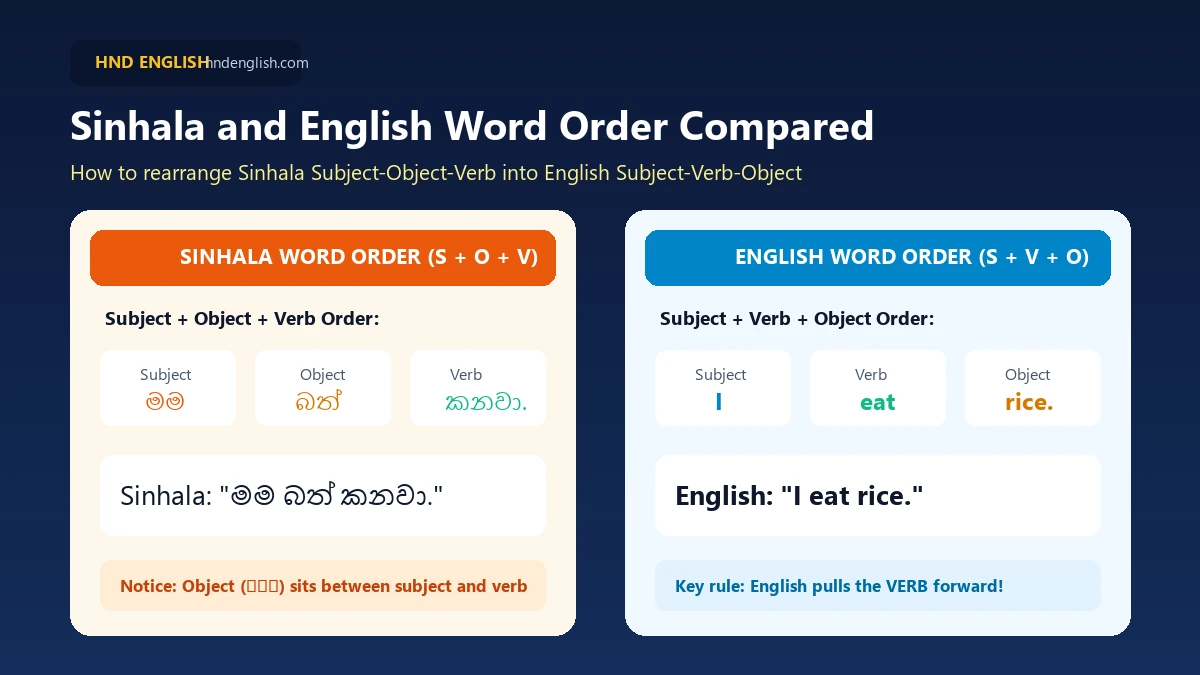
Imagine translating: මම බත් කනවා.
- මම = I (Subject)
- බත් = rice (Object)
- කනවා = eat (Verb)
A word-for-word arrangement produces "I rice eat" (awkward). But natural English pulls the verb forward: "I eat rice."
| Sentence Component | Sinhala Order (SOV) | English Order (SVO) |
|---|---|---|
| Subject (කර්තෘ) | මම | I |
| Object (කර්මය) | බත් | rice |
| Verb (ක්රියාව) | කනවා | eat |
| Full Sentence | මම බත් කනවා. | I eat rice. |
The subject tells us who or what the sentence is about. In English, the subject pronoun controls the form of the verb:
| Sinhala Pronoun | English Pronoun | Example Sentence |
|---|---|---|
| මම | I | I study English |
| ඔයා / ඔබ | You | You work hard |
| ඔහු | He | He works in Colombo |
| ඇය | She | She studies English |
| අපි | We | We play cricket |
| ඔවුන් | They | They speak English |
| ඒක | It | It works well |
Base Verb (No -s):
Verb + -s / -es:
For deeper fundamentals, read our guide to Word Classes in English.
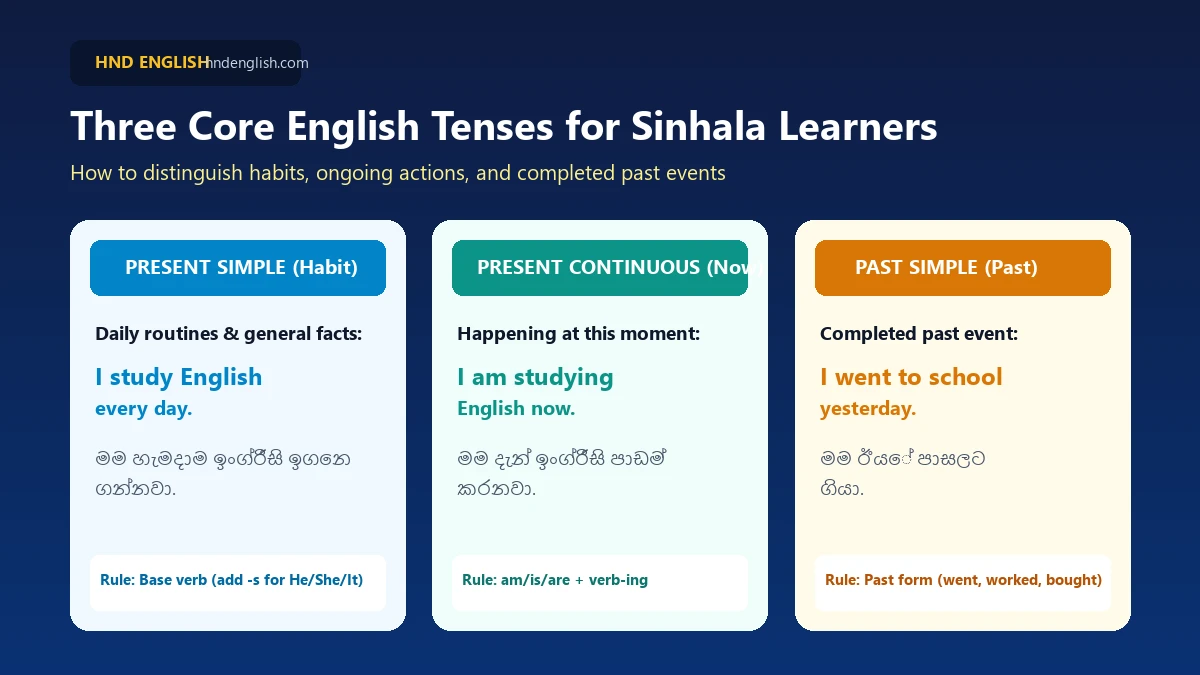
When translating from Sinhala, ask: Is this a regular habit, an action happening right now, or a completed past event?
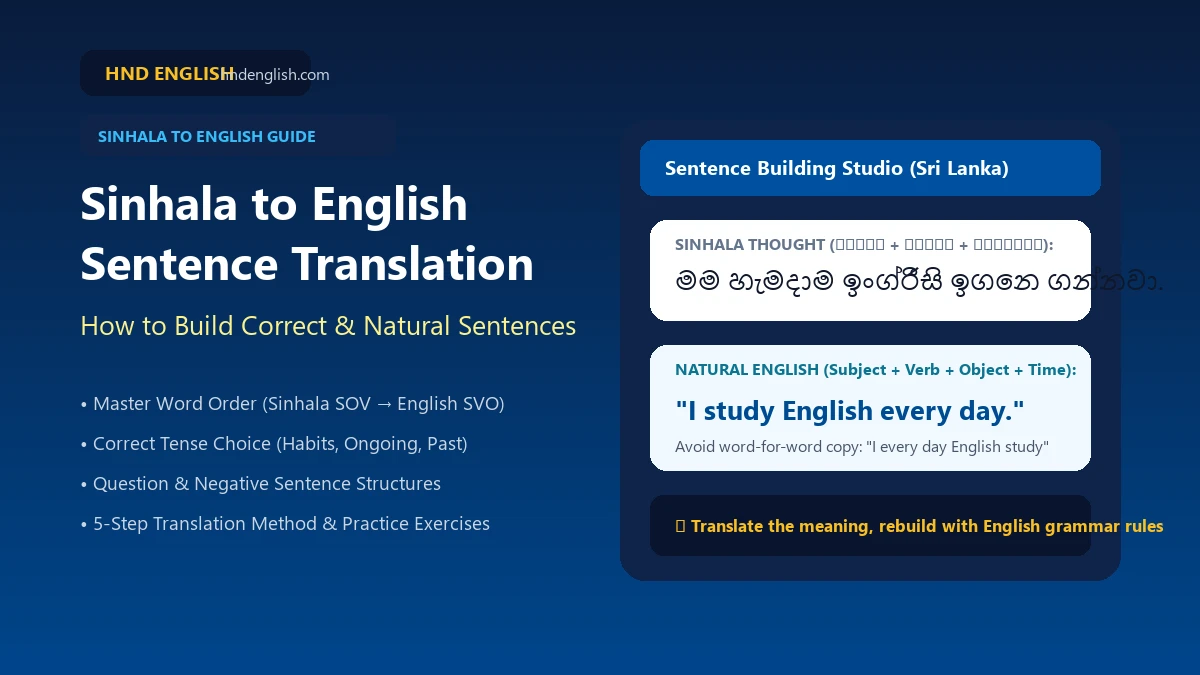
Sinhala: මම හැමදාම ඉංග්රීසි ඉගෙන ගන්නවා.
Natural English: "I study English every day."
Used for routines, repeated activities, and general truths.
Sinhala: මම දැන් ඉංග්රීසි පාඩම් කරනවා.
Natural English: "I am studying English now."
Formula: Subject + am/is/are + verb-ing.
Sinhala: මම ඊයේ පාසලට ගියා.
Natural English: "I went to school yesterday."
Formula: Subject + past verb form (went, worked, bought).
In Sinhala, you may ask: ඔයා කොහෙද යන්නේ?
❌ Incorrect literal: Where you are going?
✅ Natural English: "Where are you going?"
English questions invert the auxiliary verb and subject: Question Word + Auxiliary (are) + Subject (you) + Verb (going)?
Questions with Do and Does (Present Simple):
| Sinhala Question | Natural English |
|---|---|
| ඔයා ඉංග්රීසි කතා කරනවද? | Do you speak English? |
| ඔයා කොහෙද ජීවත් වෙන්නේ? | Where do you live? |
| ඇය කොහෙද වැඩ කරන්නේ? | Where does she work? |
| ඔවුන් ක්රිකට් සෙල්ලම් කරනවද? | Do they play cricket? |
Notice that after does, the main verb returns to base form: "Where does she work?" (not works).
When translating negative thoughts like මම ඒක දන්නේ නැහැ, English uses:
Subject + do not / does not (don't / doesn't) + Base Verb
Ordinary Verbs (use don't / doesn't):
Verb "to be" (add not directly):
Direct Sinhala commands like මට උදව් කරන්න translate directly as "Help me", which can sound abrupt in professional English. Instead, use courteous question patterns:
| Sinhala Request | Natural Polite English |
|---|---|
| මට උදව් කරන්න පුළුවන්ද? | Could you please help me? |
| කරුණාකර ආයෙත් කියන්න. | Could you please say that again? |
| මට ඇතුළට එන්න පුළුවන්ද? | May I come in? |
| කරුණාකර ටිකක් ඉන්න. | Could you wait a moment, please? |
| මට මේක පැහැදිලි කරලා දෙන්න පුළුවන්ද? | Could you explain this to me? |
Everyday Situation: At a College Examination Office
I rice eat.
✅ Correct: I eat rice.
I student.
✅ Correct: I am a student.
She bought book.
✅ Correct: She bought a book.
I am going to home.
✅ Correct: I am going home.
I studying now.
✅ Correct: I am studying now.
Yesterday I go to Kandy.
✅ Correct: Yesterday I went to Kandy.
Why you are late?
✅ Correct: Why are you late?
He go to work every day.
✅ Correct: He goes to work every day.
For advanced practice changing statements into questions and negatives, visit our guide on Transformation of Sentences.
මේ බස් එක කොළඹට යනවද?
"Does this bus go to Colombo?"
Pattern: Does + this bus + go to [Destination]?
මම තවම පැවරුම ඉවර කරලා නැහැ.
"I haven't finished the assignment yet."
Pattern: Present perfect for unfinished work.
මම හෙට ඊමේල් එක එවන්නම්.
"I'll send the email tomorrow."
Pattern: I will (I'll) for future promise.
මේක කීයද?
"How much is this?"
Short, practical, and clear.
Let's apply our method to: ඇය හැමදාම උදේට පාසලට යනවා.
Describes a regular routine: a student goes to school every morning.
ඇය = She (3rd person singular).
හැමදාම indicates a habit → Present Simple.
Verb is go (+es for She = goes). Place + Time = to school every morning.
"She goes to school every morning." (Perfect!)
Translation tools can be useful for looking up unfamiliar vocabulary, but always check:
- Does the translation match the real tense and intended tone?
- Did the automated tool preserve English SVO word order?
- For formal academic, legal, or examination materials, always seek human review.
Translate these 10 Sinhala sentences into English before revealing the answers:
- මම හැමදාම පාසලට යනවා.
- ඇය දැන් පොතක් කියවනවා.
- අපි ඊයේ ක්රිකට් සෙල්ලම් කළා.
- ඔයා කොහෙද ජීවත් වෙන්නේ?
- මට මේක තේරෙන්නේ නැහැ.
- ඔහු හෙට එයි.
- මම තේ බොන්න කැමතියි.
- කරුණාකර දොර වහන්න.
- ඔවුන් දැන් වැඩ කරනවා.
- ඔයා ඊයේ කොහෙද ගියේ?
👉 Click here to reveal the suggested English answers
| No. | Natural English Translation | Grammar Note |
|---|---|---|
| 1 | I go to school every day. | Present simple routine |
| 2 | She is reading a book now. | Present continuous (now) |
| 3 | We played cricket yesterday. | Past simple (yesterday) |
| 4 | Where do you live? | Do + subject + base verb |
| 5 | I don't understand this. | Negative with don't |
| 6 | He will come tomorrow. | Future action (will) |
| 7 | I like drinking tea. | Or "I like to drink tea" |
| 8 | Please close the door. | Polite request |
| 9 | They are working now. | Continuous action |
| 10 | Where did you go yesterday? | Did + subject + base verb |
| Day | Daily Grammar Focus |
|---|---|
| Day 1 | Master Subject + Verb + Object (SVO) order |
| Day 2 | Present simple habits & 3rd person singular (-s / -es) |
| Day 3 | Present continuous (am / is / are + verb-ing) |
| Day 4 | Past simple regular & irregular verbs (went, worked) |
| Day 5 | Question formation (Do / Does / Where / What) & negatives |
| Day 6 | Polite requests (Could you please...) in real situations |
| Day 7 | Write 5 original Sinhala thoughts and translate them into English |
Recommended Video: Practical English Sentences With Sinhala Support
Watch this lesson by Learn With Yuki demonstrating 50 practical English sentences with Sinhala explanations:

Frequently Asked Questions
How do I translate Sinhala into English correctly?
Start by understanding the full message of the Sinhala sentence. Identify the subject, pick the suitable tense, arrange the words in English SVO order, and verify natural flow.
What is the difference between English and Sinhala sentence structure?
English uses Subject + Verb + Object (SVO), while Sinhala uses Subject + Object + Verb (SOV). In English, the action verb is pulled forward before the object.
Is Google Translate accurate for Sinhala-to-English translation?
It can be a helpful starting point for vocabulary, but automated tools often miss contextual nuance, politeness, and correct preposition usage. Review with grammar rules or human verification.
Should I learn British English or American English?
Both are widely understood. Sri Lankan education traditionally aligns with British English conventions, but clear grammar and natural communication are what matter most.
Explore Related HND English Learning Resources:
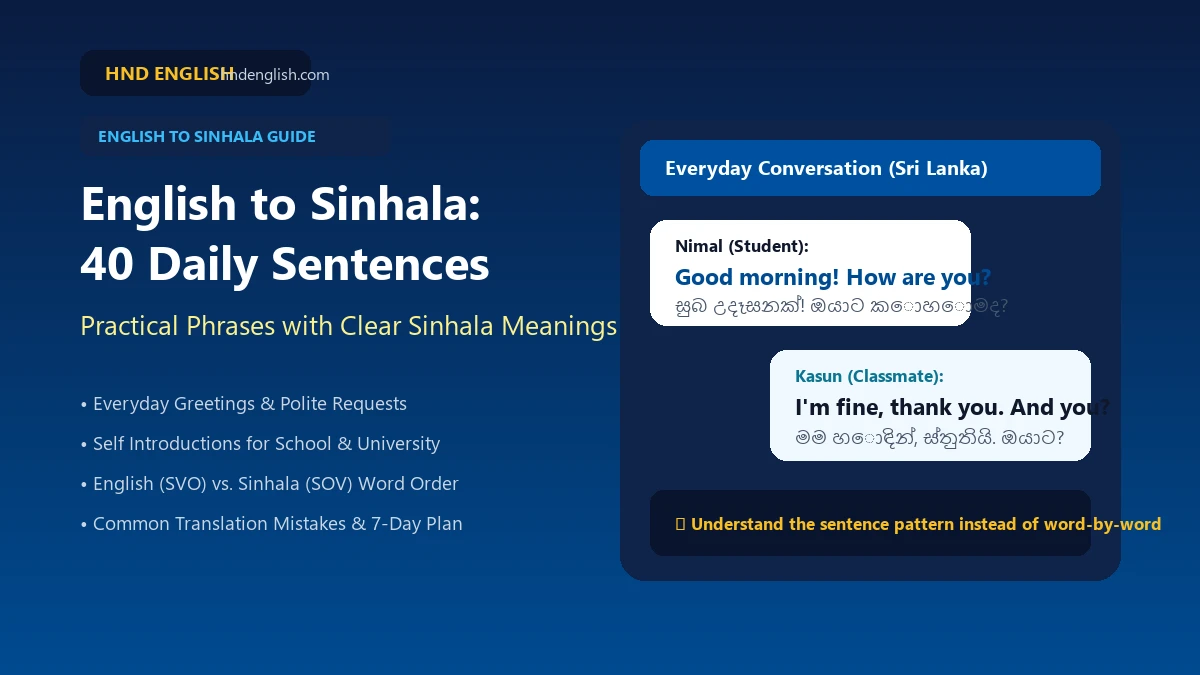
- 👉 English to Sinhala Translation: 40 Everyday Sentences You Can Actually Use
- 👉 Prepositions with Tamil & Sinhala Meanings (50+ Common Rules)
- 👉 Word Classes in English (Parts of Speech Foundation)
- 👉 Transformation of Sentences: Statements, Questions & Negatives
- 👉 Word Formation in English: Prefixes, Suffixes & Compounds
Which Sinhala sentence do you find hardest to express in English?
Share it in the comments below! We may explain its grammar and include it as an example in a future HND English lesson.
Save Complete Educational Notes as PDF
Download a clean, printer-friendly formatted PDF of this note for offline revision.
Found this study material helpful?
Rate our website service and free notes repository on Google Reviews!
Discussion & Study Inquiries (0)
Ask questions, request missing past papers, or share revision notes
No comments yet. Be the first student to start the discussion or request past papers!