You've probably experienced this while learning another language: you know exactly what you want to say in English, but when you translate the sentence, something feels slightly wrong.
Maybe a Spanish-speaking friend understands you but gives you a puzzled look. Maybe a translation app provides a sentence that seems grammatically correct but sounds unnatural. Or perhaps you discover that a Spanish word that looks almost identical to an English word means something completely different.
These situations are surprisingly common. The problem isn't always a lack of vocabulary. Often, it's the assumption that Spanish works like English with different words. It doesn't.
Good English-to-Spanish translation is about communicating the same meaning naturally, not replacing each English word with a Spanish equivalent. In this guide, we'll explore 12 common translation mistakes, see what goes wrong, and learn how to correct them with practical examples.
Target Audience: Whether you're learning Spanish for school, travel, work, or everyday conversations in the United States, these lessons will help you communicate more clearly and confidently.
Quick Reference: 12 Translation Mistakes to Avoid
If you're looking for a quick answer, start here:
| Mistake Type | Common Incorrect Translation | Natural Spanish |
|---|---|---|
| Estoy hambre | Tengo hambre | |
| Actualmente = Actually | Actualmente = Currently | |
| Soy cansado | Estoy cansado | |
| Gracias para tu ayuda | Gracias por tu ayuda | |
| La problema | El problema | |
| Yo estudio, yo trabajo, yo vivo... | Estudio, trabajo y vivo... | |
| Un rojo coche | Un coche rojo | |
| Veo María | Veo a María | |
| Yo gusto el café | Me gusta el café | |
| Sé a María | Conozco a María | |
| Ayer iba al cine | Ayer fui al cine | |
| ¿Cómo estás, señor? | ¿Cómo está usted, señor? |
*These examples show common learner errors in specific contexts. Some constructions have different nuances or become acceptable in other settings, so the full explanations below matter.
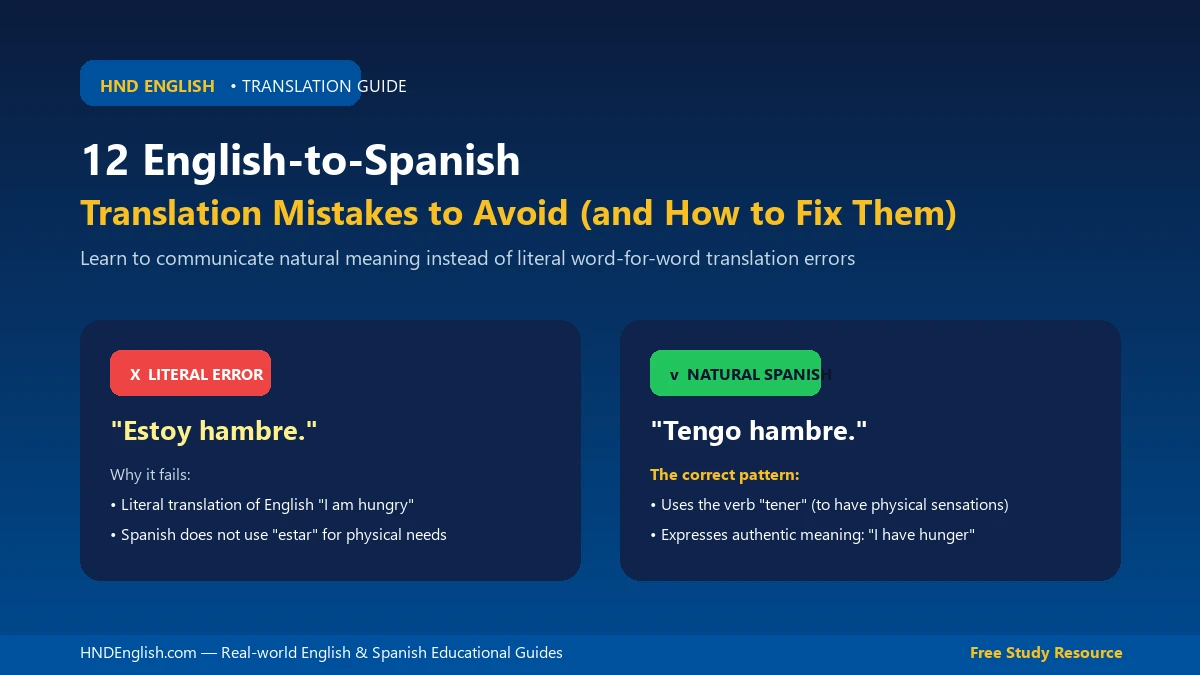
Imagine you're having lunch with a Spanish-speaking coworker. You want to say, "I'm hungry."
If you translate the words individually, you might try:
❌ Incorrect literal:
Estoy hambre.✅ Natural Spanish:
Tengo hambre.The Spanish expression literally follows a structure similar to "I have hunger." English uses the verb to be for many physical conditions, while Spanish uses tener (to have) in several familiar expressions.
More Everyday Expressions with Tener:
| English Meaning | Natural Spanish | Literal Meaning |
|---|---|---|
| I'm hungry | Tengo hambre | I have hunger |
| I'm thirsty | Tengo sed | I have thirst |
| I'm cold | Tengo frío | I have cold |
| I'm hot | Tengo calor | I have heat |
| I'm afraid | Tengo miedo | I have fear |
| I'm 25 years old | Tengo 25 años | I have 25 years |
💡 How to Avoid This Mistake: When you encounter a common English expression, ask yourself whether Spanish uses the same grammatical structure. Learn expressions like tener hambre and tener sed as complete phrase chunks. You'll begin recalling natural expressions without translating every word mentally.
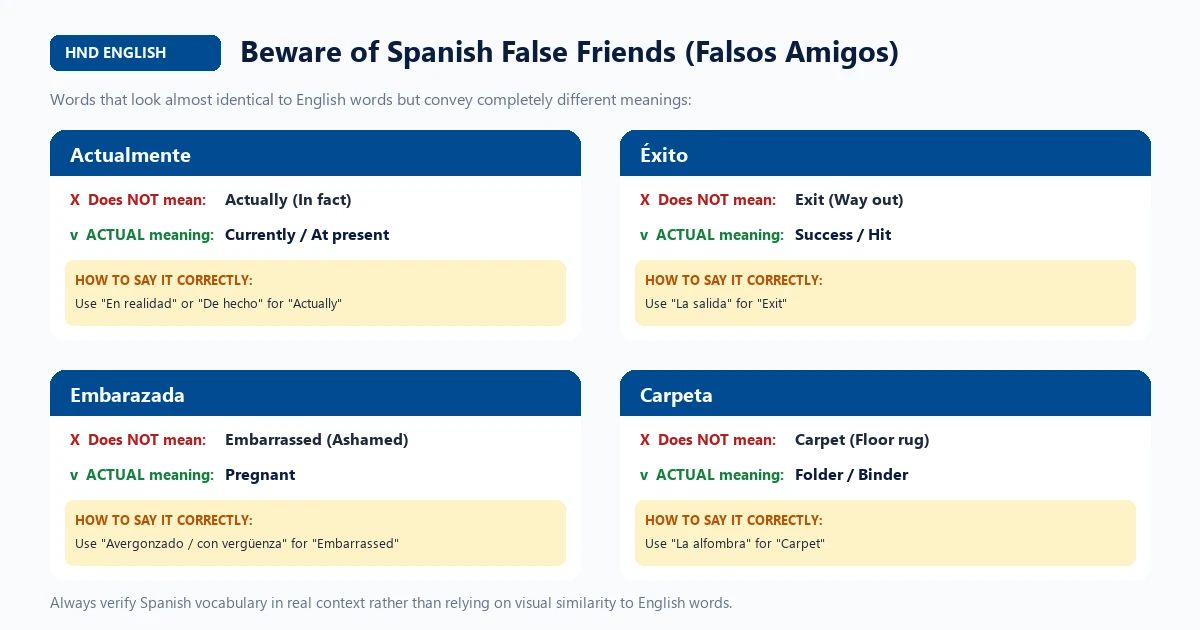
Some of the most misleading translation mistakes involve words that look familiar. In language learning, these are often called false friends (or false cognates): words that resemble words in English but have completely different meanings.
For example, actualmente looks like the English word actually. But actualmente means currently or at present. To express "actually" in the sense of "in fact," native speakers say en realidad or de hecho.
Common Spanish False Friends to Watch Out For:
| Spanish Word | Actual Meaning | Easily Confused With |
|---|---|---|
| Actualmente | Currently, right now | Actually (use en realidad) |
| Embarazada | Pregnant | Embarrassed (use avergonzado/a) |
| Éxito | Success | Exit (use salida) |
| Carpeta | Folder, binder | Carpet (use alfombra) |
| Librería | Bookstore | Library (use biblioteca) |
| Sensible | Sensitive | Sensible (use sensato/a) |
| Asistir | To attend (an event) | To assist (use ayudar) |
| Realizar | To carry out, accomplish | To realize (use darse cuenta) |
✅ Natural Spanish: En realidad, estoy muy ocupado hoy.
(Saying "Actualmente estoy muy ocupado" means "I am currently very busy", changing the intended emphasis.)
Example 2: "I need to find the exit."
✅ Natural Spanish: Necesito encontrar la salida.
(Using éxito instead of salida would mean you're searching for success, not the door!)
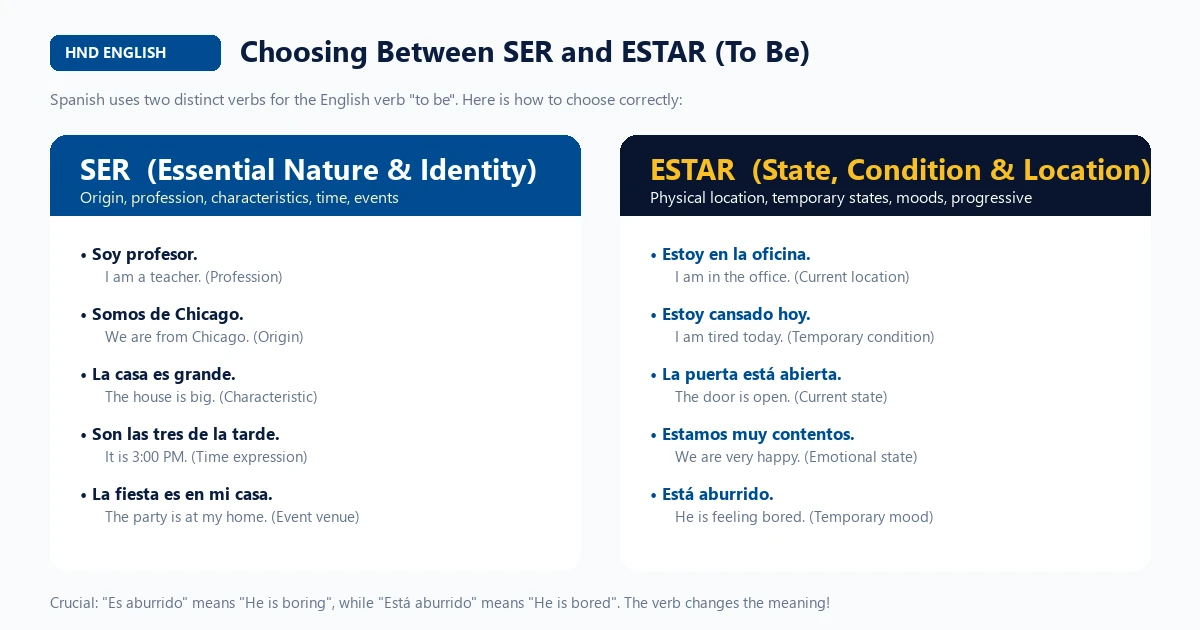
English has one main verb, to be, for sentences like: I am a teacher, I am tired, and I am at home. Spanish normally uses two different verbs for these meanings: ser and estar.
When to use SER:
Use for identity, profession, origin, time, and essential inherent characteristics.
When to use ESTAR:
Use for location, physical/mental conditions, and temporary states.
- Es aburrido: He/it is boring (inherent character).
- Está aburrido: He is bored (temporary state).
- Es verde: It is green (color).
- Está verde: It is unripe (condition).
Both por and para can translate to "for" in English, but they are not interchangeable.
❌ Incorrect:
Gracias para tu ayuda.✅ Correct:
Gracias por tu ayuda.Now compare that with: "Este regalo es para ti" (This gift is for you). Why does the preposition change?
POR = Cause, Reason, Exchange, Route
PARA = Destination, Recipient, Purpose, Deadline
English nouns generally do not have grammatical gender. Spanish nouns do. And noun gender controls the articles and adjectives describing it.
A beginner might assume that all nouns ending in -a are feminine. But there are important exceptions:
❌ Incorrect: La problema es grande.
✅ Correct: El problema es grande.
(Nouns of Greek origin ending in -ma like el problema, el sistema, el tema, and el idioma are masculine!)
💡 Rule of thumb: Always memorize new Spanish nouns together with their definite article: learn el problema instead of just problema, and la casa instead of just casa.
English normally requires subject pronouns: "I study Spanish. I work in a restaurant. I live in New York."
Spanish often allows the subject pronoun to be omitted because the verb ending already specifies the subject:
⚠️ Unnatural & repetitive: Yo estudio español. Yo trabajo en un restaurante. Yo vivo en Nueva York.
 HND English
✅ Natural & fluent: Estudio español, trabajo en un restaurante y vivo en Nueva York.
Subject pronouns like yo, tú, and ella are used explicitly in Spanish when needed for emphasis or contrast: "Yo quiero café, pero ella quiere té" (I want coffee, but she wants tea).
In English, adjectives generally come before nouns: a red car, a beautiful city. In Spanish, descriptive adjectives normally come after the noun:
- Un coche rojo (not un rojo coche)
- Una ciudad hermosa
- Un libro interesante
Nuance: Meaning Changes with Placement:
For a full refresher on grammatical categories, visit our resource on Word Classes in English.
Spanish has a grammatical feature called the personal a. It appears before a direct object referring to a specific person or pet:
❌ Incorrect:
Veo María.✅ Correct:
Veo a María.Compare: "Veo un coche" (I see a car — inanimate object, no a) vs. "Veo a mi hermana" (I see my sister — specific person, requires a).
English uses the pattern "I like coffee." Beginners frequently try to translate this literally as "Yo gusto el café." This is incorrect!
Spanish expresses liking through gustar, which literally translates as "to be pleasing to":
English uses "know" for facts, skills, places, and people. Spanish makes a strict distinction between saber and conocer:
SABER = Facts, Info, Skills
CONOCER = People, Places, Familiarity
Spanish has two main past tenses: the preterite (for completed actions with specific endpoints) and the imperfect (for habitual actions, ongoing background states, or descriptions in the past).
| English Context | Spanish Sentence | Tense Used |
|---|---|---|
| Yesterday, I went to the movies | Ayer fui al cine | Preterite (completed event) |
| When I was a child, I went to the movies every Saturday | Cuando era niño, iba al cine todos los sábados | Imperfect (repeated habit) |
In English, "you" works in every situation. Spanish distinguishes between informal address (tú) and formal respectful address (usted):
Informal (friends & peers):
¿Cómo estás?
Used with family, friends, children, and close coworkers.
Formal (clients & elders):
¿Cómo está usted?
Used with older adults, new clients, authority figures, and in formal business.
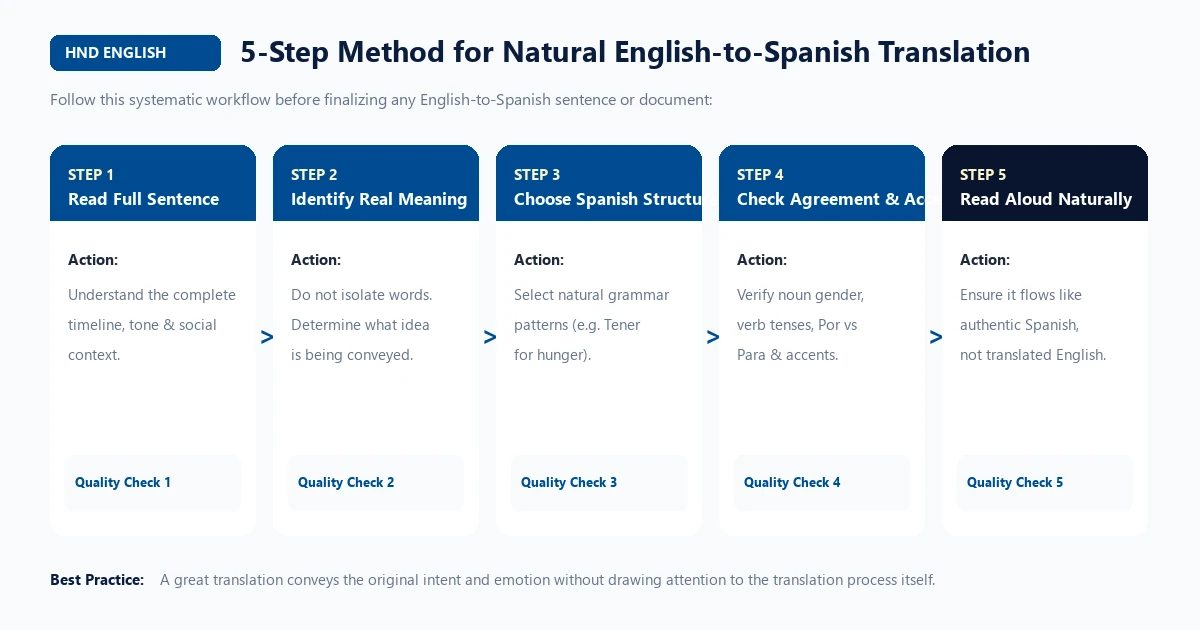
A Practical Five-Step Method for Better English-to-Spanish Translation
Suppose you need to translate: "I have been living in Chicago for three years." Translating word-for-word creates awkward syntax. Instead, use this 5-step method:
Identify the timeline: the speaker moved to Chicago 3 years ago and still lives there today.
Focus on the ongoing duration rather than matching the auxiliary verb "have been".
Natural options: "Llevo tres años viviendo en Chicago" or "Vivo en Chicago desde hace tres años."
Verify gender, number agreement, verb conjugations, and accent marks.
Ask whether a native speaker would say this sentence without feeling English word patterns underneath.
Try It Yourself: Five Translation Exercises
Before checking the answers, try translating these 5 sentences into Spanish:
- I'm 20 years old.
- I know María.
- Thank you for your help.
- I like these books.
- Yesterday, I bought a new phone.
👉 Click here to reveal the answers and explanations
| English | Spanish Answer | Key Grammar Rule |
|---|---|---|
| I'm 20 years old | Tengo veinte años | Age uses tener |
| I know María | Conozco a María | Conocer + personal a |
| Thank you for your help | Gracias por tu ayuda | Por for reasons, not para |
| I like these books | Me gustan estos libros | Plural agreement with gustan |
| Yesterday, I bought a new phone | Ayer compré un teléfono nuevo | Preterite for completed past action |
Recommended Video: Common Spanish Mistakes Explained
Watch this engaging lesson by Spanish and Go covering 11 common mistakes Spanish learners make and practical ways to correct them:

Frequently Asked Questions
What is the most common English-to-Spanish translation mistake?
Literal word-for-word translation is the most common error because English and Spanish often use fundamentally different grammatical structures (such as tener for physical states and gustar for preferences).
Why does Google Translate sometimes sound unnatural?
Automatic translation may generate a grammatically valid sentence while missing subtle social context, formal versus informal address, regional slang, and cultural nuances.
What are false friends in Spanish?
False friends (false cognates) are words that look visually similar in both languages but mean completely different things, like actualmente (currently, not actually) and éxito (success, not exit).
Is ser or estar more common in Spanish?
Both verbs are essential. Rather than seeking the more common one, learn their distinct functional purposes: ser for identity and inherent traits, and estar for location and conditions.
Which English expression has been the hardest for you to translate into Spanish?
Share your experience in the comments below! Your question or insight might help another learner navigate tricky Spanish translations.