Imagine you're translating a short English message into Hindi. The sentence looks simple: "My book is on the table."
You know that book means किताब, table means मेज़, and my means something like मेरा. But after putting the words together, you're not entirely sure whether the translation is correct. Should you write मेरा किताब or मेरी किताब? And where should the word meaning "on" go?
This is where English-to-Hindi translation becomes much more than a vocabulary exercise. Hindi and English differ in word order, grammatical gender, verb agreement, politeness levels, and how relationships between words are expressed.
A translation can contain all the right dictionary words and still sound unnatural or grammatically incorrect. The key is to translate the meaning while following Hindi grammar—not simply replace English words one by one.
In this troubleshooting guide, we'll explore 15 common English-to-Hindi translation mistakes, explain why they happen, and demonstrate how to correct them. You'll also find practical examples, grammar comparisons, translation exercises, and a checklist you can use whenever you're uncertain about a Hindi sentence.
💡 Target Audience: Beginners and intermediate Hindi learners, students in India preparing for bilingual exams, and anyone translating everyday English into natural Hindi.
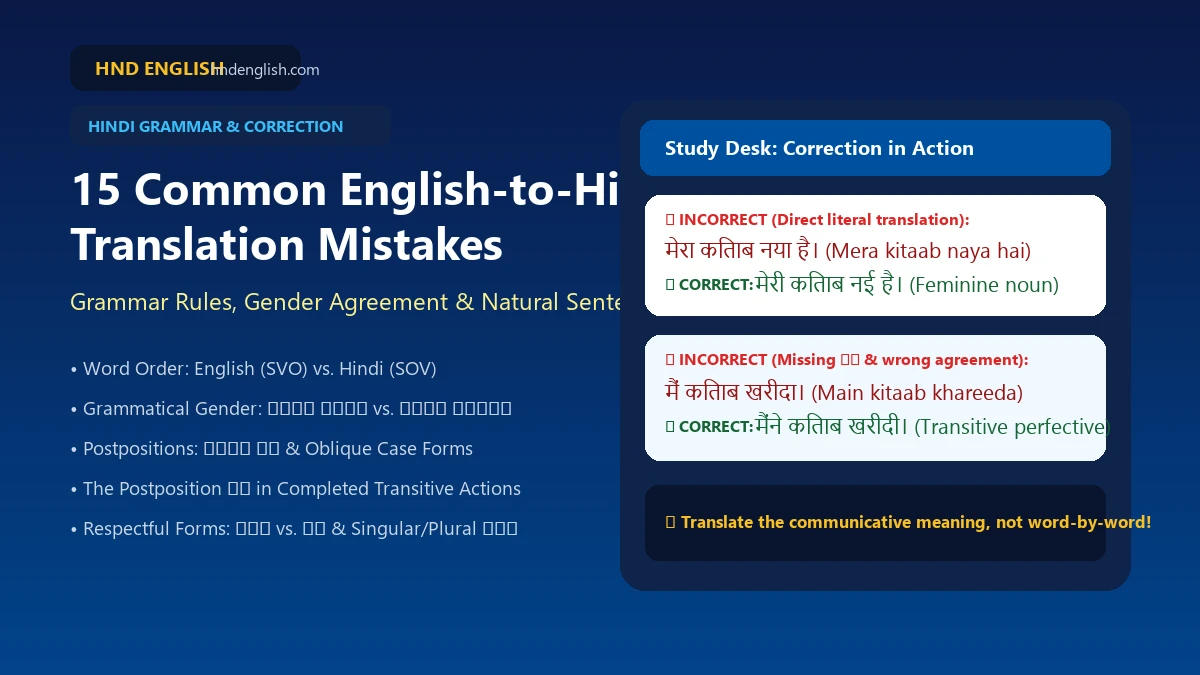
⚡ Quick Answer: Common English-to-Hindi Mistakes
If you want to identify and fix common translation errors immediately, start with this reference:
| Intended Meaning | Incorrect Hindi (अशुद्ध) | Correct Hindi (शुद्ध) | Core Grammar Rule |
|---|---|---|---|
| My book | मेरा किताब | मेरी किताब | Feminine noun agreement |
| My room | मेरी कमरा | मेरा कमरा | Masculine noun agreement |
| He reads a book | वह पढ़ता है किताब | वह किताब पढ़ता है। | Hindi SOV word order |
| I am reading | मैं पढ़ रहा | मैं पढ़ रहा हूँ। | Auxiliary verb हूँ required |
| You are ready (polite) | आप तैयार है। | आप तैयार हैं। | Honorific plural agreement |
| I bought a book | मैंने किताब खरीदा। | मैंने किताब खरीदी। | Object agreement with ने |
These errors involve several distinct grammar principles: gender agreement, word order, postpositions, and honorific forms. The explanations below show how each rule functions.
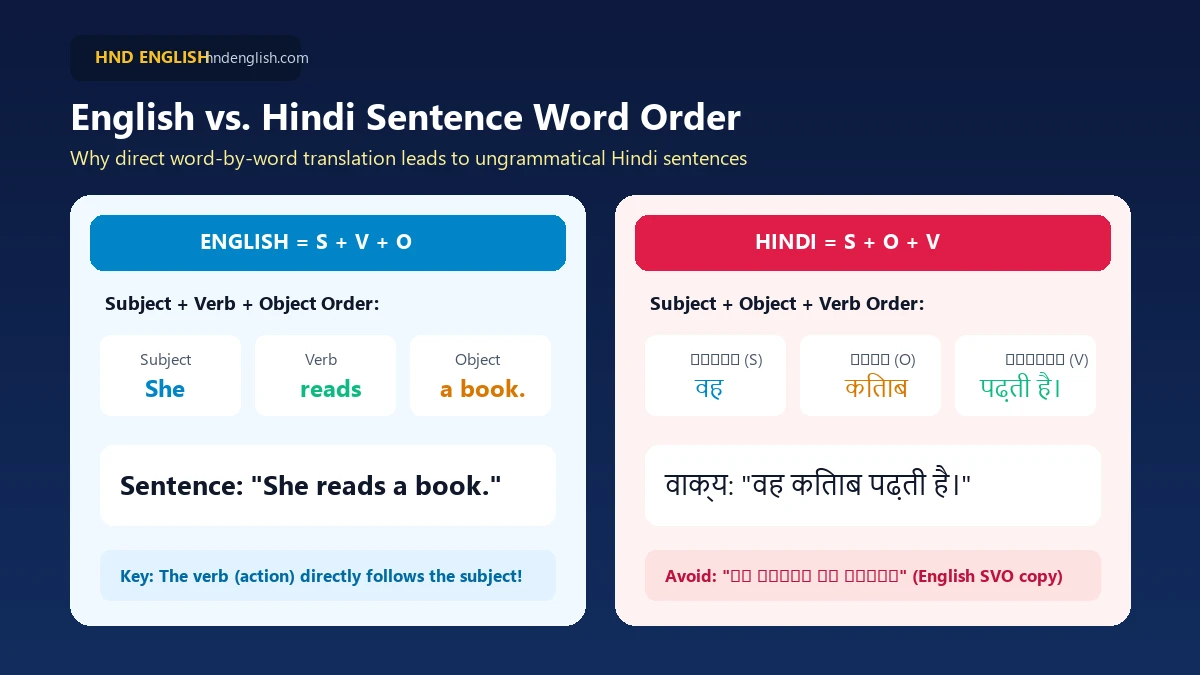
English commonly follows Subject + Verb + Object (SVO). Hindi commonly follows Subject + Object + Verb (SOV).
Notice how the word किताब (book) appears before the main verb पढ़ती है. Another everyday example:
- English: I drink tea.
- Hindi (Male speaker): मैं चाय पीता हूँ। (Main chai peeta hoon)
- Hindi (Female speaker): मैं चाय पीती हूँ। (Main chai peeti hoon)
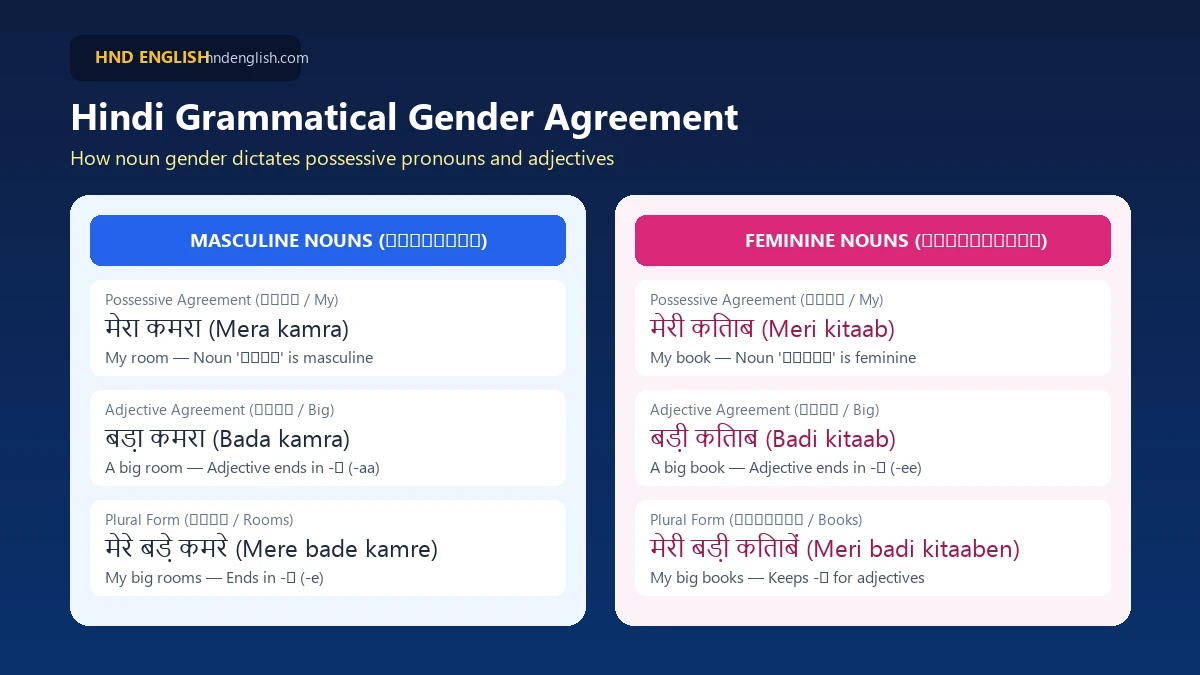
Every Hindi noun possesses a grammatical gender (masculine or feminine). In English, inanimate objects like books and rooms have no grammatical gender, which confuses beginner translators.
- किताब (book) is feminine.
- कमरा (room) is masculine.
| English | Incorrect | Correct Hindi | Gender |
|---|---|---|---|
| My book | मेरा किताब | मेरी किताब | Feminine |
| My room | मेरी कमरा | मेरा कमरा | Masculine |
| My car | मेरा गाड़ी | मेरी गाड़ी | Feminine |
| My house | मेरी घर | मेरा घर | Masculine |
| My chair | मेरा कुर्सी | मेरी कुर्सी | Feminine |
Variable Hindi adjectives change their endings according to the grammatical gender and number of the noun they describe.
English places prepositions before the noun (e.g. on the table, in the room). Hindi uses postpositions that appear after the noun.
| English Prepositional Phrase | Hindi Postpositional Phrase | Postposition Used |
|---|---|---|
| On the table | मेज़ पर | पर (on) follows मेज़ |
| In the room | कमरे में | में (in) follows कमरे |
| With a friend | दोस्त के साथ | के साथ (with) follows दोस्त |
| From Delhi | दिल्ली से | से (from) follows दिल्ली |
| Under the chair | कुर्सी के नीचे | के नीचे (under) follows कुर्सी |
Example sentence: "The book is on the table" translates directly as किताब मेज़ पर है। (Book + Table on + is).
When a masculine noun or pronoun is followed by a postposition, it changes from its direct form to its oblique form:
- मेरा भाई (My brother) → मेरे भाई के साथ (With my brother — मेरा becomes मेरे).
- मेरा कमरा (My room) → मेरे कमरे में (In my room — कमरा becomes कमरे).
In English, the verb "read" does not change based on whether the speaker is a man or a woman. In Hindi habitual sentences, it does:
English distinguishes between habitual facts ("I read") and ongoing actions happening now ("I am reading"). Hindi does the same:
| English Tense | Male Speaker | Female Speaker |
|---|---|---|
| Habitual (I study Hindi every day) | मैं हर दिन हिंदी पढ़ता हूँ। | मैं हर दिन हिंदी पढ़ती हूँ। |
| Continuous (I am studying Hindi now) | मैं अभी हिंदी पढ़ रहा हूँ। | मैं अभी हिंदी पढ़ रही हूँ। |
Pay attention to time markers like अभी (now) versus हर दिन (every day) to determine the right aspect.
8 & 9. The Postposition 'ने' & Object Agreement in Completed Actions
One of the most frequent hurdles in Hindi grammar is the ergative postposition ने in completed transitive actions (perfective aspect):
Mistake 9: Assuming the Verb Always Agrees with the Subject
 HND English
When ने marks the subject, the verb often agrees with the direct object (if unmarked):
| English Sentence | Hindi Translation | Why Verb Changes |
|---|---|---|
| I bought a book | मैंने किताब खरीदी। | किताब is feminine → खरीदी |
| I bought a pen | मैंने पेन खरीदा। | पेन is masculine → खरीदा |
| Sita bought clothes | सीता ने कपड़े खरीदे। | कपड़े is masc. plural → खरीदे |
10 & 11. Mixing Up 'तुम' vs. 'आप' and 'है' vs. 'हैं'
English uses a single word "you" for friends, strangers, children, and elders. Hindi distinguishes between familiar and respectful address:
Mistake 11: Using 'है' Instead of 'हैं'
Even when आप refers respectfully to a single individual, it takes the honorific plural verb ending हैं (with anusvara):
In English, "don't" is used for both ordinary negation and direct commands. In Hindi:
- Statement of fact: मैं वहाँ नहीं जाता हूँ। (I don't go there — uses नहीं).
- Negative command: वहाँ मत जाओ। (Don't go there — uses मत).
| English Command | Standard Hindi Command | Polite / Formal Form |
|---|---|---|
| Don't go | मत जाओ। | कृपया मत जाइए। |
| Don't worry | चिंता मत करो। | चिंता मत कीजिए। |
| Don't touch this | इसे मत छुओ। | इसे मत छुइए। |
English uses "have" for physical possessions, family relationships, and physical sensations. Hindi uses different grammatical structures for each:
The Hindi word कल (kal) can mean either yesterday or tomorrow. The intended meaning is determined entirely by the verb tense and surrounding context:
- Past (Yesterday): मैं कल दिल्ली गया था। (I went to Delhi yesterday — past tense गया था).
- Future (Tomorrow): मैं कल दिल्ली जाऊँगा। (I will go to Delhi tomorrow — future tense जाऊँगा).
Literal translations of English idioms produce confusing Hindi. You must translate the communicative intention:
| English Expression | Communicative Meaning | Natural Hindi Expression |
|---|---|---|
| I miss you | I feel your absence | मुझे तुम्हारी याद आती है। |
| Take your time | There's no hurry | आराम से कीजिए / कोई जल्दी नहीं है। |
| I'm on my way | Travelling toward you | मैं रास्ते में हूँ। |
| Give me a hand | Help me | मेरी मदद करो / सहायता कीजिए। |
| It's up to you | You can decide | यह आप पर निर्भर है। |
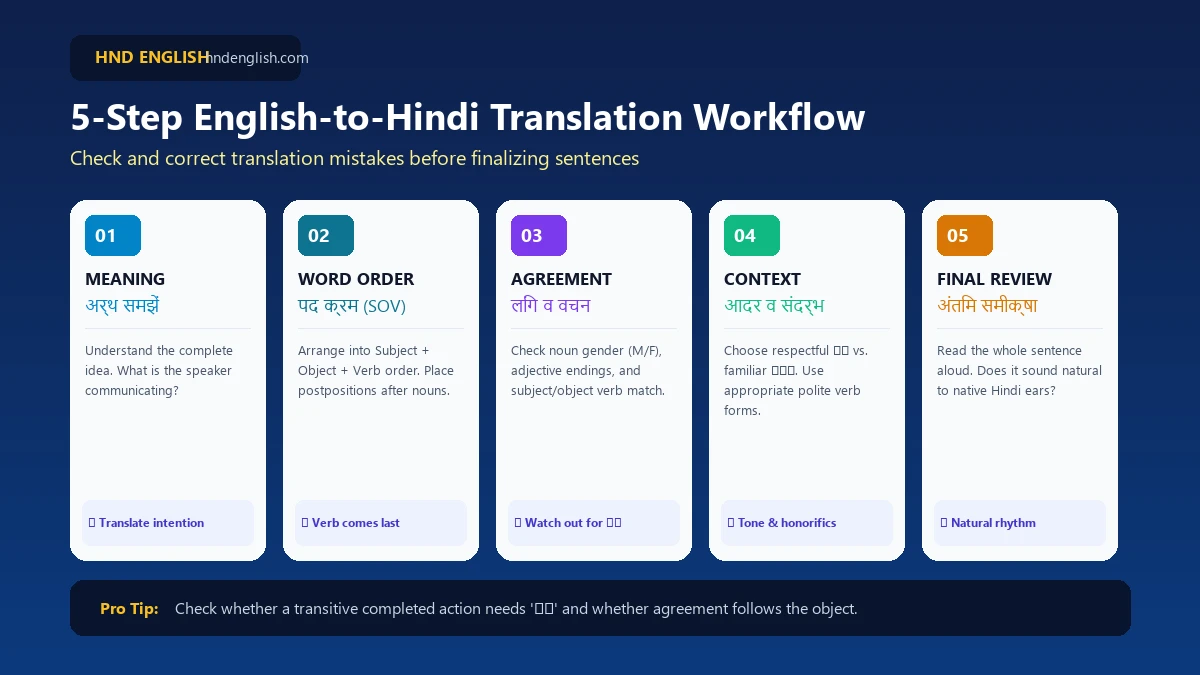
A Five-Step Method for Better English-to-Hindi Translation
Let's apply these lessons to translate: "I bought a new book yesterday."
Try It Yourself: English-to-Hindi Translation Exercises
Test what you've learned. Try correcting these 8 sentences before clicking to reveal the answers:
1. Gender Agreement:
English: "My book is new." | Incorrect: मेरा किताब नया है।👉 Reveal Answer
2. Word Order:
English: "She drinks tea." | Incorrect: वह पीती है चाय।👉 Reveal Answer
3. Postpositions:
English: "The book is on the table." | Incorrect: किताब पर मेज़ है।👉 Reveal Answer
4. Respectful Address:
English: "Are you ready?" (polite) | Incorrect: आप तैयार है?👉 Reveal Answer
5. Completed Action:
English: "I bought a book." | Incorrect: मैंने किताब खरीदा।👉 Reveal Answer
6. Habitual vs. Continuous:
English: "She is reading now." | Incorrect: वह अभी पढ़ती है।👉 Reveal Answer
7. Negative Command:
English: "Don't go there." | Incorrect: वहाँ नहीं जाओ।👉 Reveal Answer
8. Meaning-Based Idiom:
English: "I miss you." | Which is more natural? A. Literal word-by-word or B. मुझे तुम्हारी याद आती है।👉 Reveal Answer
Can Google Translate Help You Avoid Hindi Translation Mistakes?
Google Translate is a helpful tool for quick vocabulary checks and deciphering unfamiliar messages, but it requires human verification:
✓ Where It Helps:
- Looking up individual unfamiliar Hindi words.
- Checking alternative vocabulary synonyms.
- Quick gist comprehension of incoming messages.
⚠️ Where It Stumbles:
- Deciding speaker gender (मैं गया था vs. मैं गई थी).
- Honorific distinctions (तुम vs. आप).
- Idiomatic nuances and cultural context.
Strengthen Your Hindi & English Grammar Foundations:
Recommended Educational Resource: Michigan State University Basic Hindi
Explore instructor-led open learning materials explaining grammatical gender, postpositions, and perfective verb agreement:
Frequently Asked Questions About English-to-Hindi Translation
What are the most common English-to-Hindi translation mistakes?
Common mistakes include copying English SVO word order, mismatched noun gender, adjective agreement errors, prepositions before nouns instead of postpositions after, forgetting 'ने' in completed transitive actions, and translating idioms literally.
Does Hindi always use Subject–Object–Verb order?
SOV is the standard neutral sentence order. However, Hindi word order allows flexibility for stylistic emphasis. Beginners should master the SOV foundation before exploring variations.
Why does Hindi use मेरा and मेरी?
These forms reflect grammatical agreement with the possessed noun. मेरा कमरा uses a masculine noun, while मेरी किताब uses a feminine noun.
What is the difference between है and हैं?
है appears with singular third-person subjects, while हैं is used with plural and honorific forms, including respectful आप.
When should I use 'ने' in Hindi?
ने marks the subject in completed transitive actions (perfective aspect). It is not required with intransitive verbs (e.g. वह गया) or ongoing actions.
How do I translate English idioms naturally into Hindi?
Identify the communicative meaning of the entire expression, then choose a natural Hindi equivalent (e.g. I miss you → मुझे तुम्हारी याद आती है).
Final Thoughts: Correct Translation Begins With Understanding
English-to-Hindi translation is not simply about knowing the meaning of individual words. It's about understanding how the two languages express the same idea. Start with common mistakes, practice the correct forms, observe how grammar behaves in several sentences, and gradually move from word-for-word translation toward natural communication.